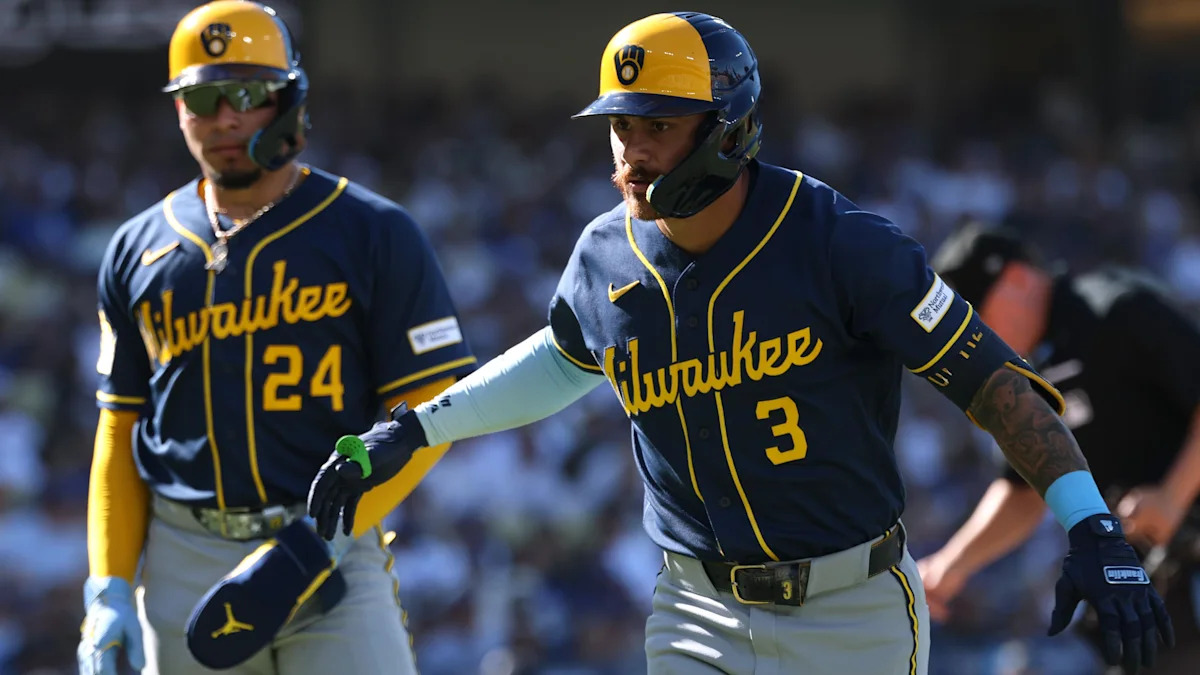
The Tampa Bay Rays and Milwaukee Brewers have both clinched playoff spots, and both are currently on pace to be the top seed in their respective leagues. They have done it despite each having a lower payroll than the Royals. The Brewers spent $145.6 million – less than half what the last place Mets spent – while the Rays had the third-lowest payroll in baseball at $96 million.
Whether those financial limitations will limit their postseason success remains to be seen. But there is no question the Royals should be looking at what both teams have accomplished during the regular season. After two modest winning seasons, the Royals have regressed badly into a last place finish. Tampa Bay and Milwaukee have shown that it is possible to win a lot of games without spending like a large-market team, a model the Royals should try to emulate.
Advertisement
A different approach to offense
The Brewers are second in baseball in runs scored while the Rays are eleventh. They have scored runs despite a lack of power. The Rays are tied with the Royals for 22nd in home runs, and the Brewers are dead last. Instead, they score runs the old-fashioned way – by hitting the ball on the ground, getting on base, and stealing bases. Batting average has become a bit passé, but the Brewers and Rays are tied for tops in baseball in that category.
How are they hitting for average in an era where batting averages are near historic lows? First of all, they put the ball in play. While strikeout rates climb, the Rays lead baseball in contact rate at 81.8 percent, while the Brewers are ninth. The Royals are fourth in contact rate, yet don’t score as many runs. Why not?
The Rays and Brewers put the ball on the ground. The Brewers lead baseball in groundball rate at 46.9 percent, the Rays are fifth. The Royals are second-to-last at 39 percent. The Royals moved in the fences, and while it has led to more home runs, the team is not suddenly putting the ball over the fence at a high rate. The Brewers are hitting .260 on ground balls (second-best in baseball), while the Royals are hitting .258, not far behind. But the Brewers have over 300 more plate appearances that have resulted in a ground ball. Meanwhile, the Royals are hitting .203 on fly balls and have the second-most plate appearances that have resulted in a fly ball. If your flyballs aren’t leaving the park, they’re likely not helping much.
Advertisement
The Brewers and Rays also hit for average by using all fields. As the league has increasingly become pull-happy, they have made a habit of going the other way. The Brewers are deliberately letting the ball travel deep before making contact, as measured by their bat orientation, allowing them to slap the ball to the opposite field. They have the lowest flyball pull rate in over a decade. And as Mike Petriello writes, by using all fields, the Brewers make themselves impossible to defend against.
Putting the ball in play, on the ground, and going to the opposite field may also be part of why the Rays and Brewers are two of the top three teams in hitting with runners in scoring position. It may also represent a bit of luck. One-third of Brewers home runs have come with runners in scoring position.
A higher batting average combined with a healthy walk rate gets at what teams need to win – runners on base. The Brewers lead baseball with a .340 on-base percentage and have the highest walk rate at 10.6 percent. They have just one hitter with at least 150 plate appearances with a walk rate under 8 percent (Sal Frelick at 7.8 percent). The Royals have five such hitters (Jac Caglianone, Starling Marte, Michael Massey, Kyle Isbel, and Salvador Perez). The lone Rays starter with a low walk rate is Chandler Simpson, who is hitting .309. The Royals have historically eschewed the ability to get on base as a skill. They have finished in the top half of the league in on-base percentage just twice in the last 20 years, with one of those coming when they won a championship in 2015.
When runners get on base, they wreak havoc on the bases. The Rays and Brewers are both among the top four in baseball in stolen bases. Seven different Brewers players are in double digits in steals.
Advertisement
The Royals have been seemingly chasing more home runs. It makes sense, home runs score runs immediately! But home run hitters are expensive. The philosophy of Moneyball was to zig while others zag. If high-contact, opposite-field, groundball hitters who can run are undervalued and can help score runs, the Royals need to be on that train.
The point isn’t even that this is the approach the Royals should follow. It’s that they need to be ahead of the curve. There are many different ways to score. The Brewers and Rays are showing that taking a different approach than the big-market teams can succeed.
Find gems in other organizations
Hall of Fame executive Pat Gillick frequently talked about the “many rivers” that teams must find talent in. Teams that win without high payrolls can’t rely on expensive free agents as their primary means of improving the roster. Instead, the Brewers and Rays are looking for underrated players in other organizations and acquiring them through shrewd trades, minor league free agency, waiver claims, and the Rule 5 draft.
Advertisement
Jake Bauers and Andrew Vaughn were each first basemen for other teams that had failed to live up to expectations. The Brewers acquired each in separate trades and this year they lead all teams in offensive production from first base. All-Star closer Trevor Megill was acquired from the Twins for a non-prospect. Chad Patrick, a 2.1 rWAR reliever, was acquired from the A’s for journeyman infielder Abraham Toro.
The Rays have been equally shrewd. They grabbed former Cuban outfield prospect Victor Mesa Jr. from the Marlins for a lottery ticket prospect, and he has become a 2.8 rWAR player in just 74 games. Reliever Kevin Kelly was a Rule 5 pick. Starting second baseman Richie Palacios was a journeyman acquired from the Cardinals for veteran reliever Andrew Kittredge.
But their biggest steal came at the expense of another smart organization, the Guardians. Little reported at the time, the Rays acquired a hard-hitting 18-year-old infielder for a promising young pitcher named Tobias Myers. The hitter blossomed with the Rays development team, and now Junior Caminero is an MVP candidate.
There is no silver bullet to finding talent. The advantage comes from being willing and able to look everywhere. You can see the Royals trying to do this in a lost season as they rotate different arms into their bullpen, looking for a solution. But it shouldn’t take a losing season to look for more talent. The Brewers and Rays have built organizations that constantly search for players they believe are undervalued, then rely on their scouting and development departments to figure out what they can do with them. They don’t need every bet to pay off because they keep making bets.
Advertisement
Sell high on players
What is perhaps most surprising about the success of the Brewers and Rays is that it has come after they recently traded away some major parts of their rosters. Last winter, the Brewers traded star pitcher Freddy Peralta, starting third baseman Caleb Durbin, outfielder Isaac Collins and reliever Nick Mears to the Royals. The Rays traded All-Star second baseman Brandon Lowe, outfielders Josh Lowe and Jake Mangum, and pitcher Shane Baz over the offseason.
The Caleb Durbin trade is perhaps the best example of how the Brewers operate. Milwaukee acquired Durbin from the Yankees in 2024 after selling high on All-Star closer Devin Williams and shipping him to New York. Durbin then had an excellent rookie season, finishing third in NL Rookie of the Year voting after hitting .256/.326/.404 with 11 home runs, 53 RBI and 18 stolen bases. Rather than becoming attached to a player they had just developed into a valuable major-leaguer, the Brewers traded Durbin to Boston this winter for pitchers Kyle Harrison and Shane Drohan and infielder David Hamilton. Harrison and Drohan are now part of Milwaukee’s pitching staff, while Hamilton has contributed as a versatile infielder. In other words, the Brewers essentially turned one year of Devin Williams into a major-league closer’s replacement, a promising young starting pitcher and additional organizational depth.
Not all of these trades have produced immediate major-league value for either organization. Many of the returns consist of prospects who are still in the minors or players who have made relatively little impact in the majors. The Brewers also sold high on Isaac Collins after one surprisingly good rookie year, but they received Angel Zerpa from the Royals, and he has been hurt most of the year.
Advertisement
And yet the Brewers and Rays haven’t fallen apart. They have continued to win because their organizations are built to absorb the loss of established players, while building for sustainable success over the long term. In recent years, the Rays have traded away Isaac Paredes, Randy Arozarena, and Jason Adam, while the Brewers have traded away Williams and Corbin Burnes. They are constantly adding players, developing them and creating enough depth that they can afford to trade from the major-league roster when the opportunity arises.
Trading players away when their value is at its greatest takes being realistic about future projections and player evaluations of your own team. In finance, the disclaimer is “past performance is no guarantee of future results.” That applies to baseball player performance as well.
Develop a great farm system
The Rays and Brewers also demonstrate why a strong farm system is about more than finding the next superstar. Building depth gives an organization options. Both teams have been able to trade established major leaguers, graduate prospects to the big leagues and use prospects in trades to address major-league needs without exhausting their supply of talent. The Rays traded eight prospects from their Top 30 at the deadline this year to acquire Freddy Peralta, Liam Hicks, and Tyler Wells, yet MLB Pipeline still ranked their farm system second in baseball afterward. The Brewers have graduated several players to the majors this year and traded prospects while still maintaining one of baseball’s deepest systems.
Advertisement
How do they do it? Neither organization relies solely on high draft picks. Milwaukee hasn’t had a top-10 pick since 2017, yet MLB Pipeline ranked its system #1 entering this season. Cy Young favorite Jacob Misiorowski, a fireballer who grew up in the Kansas City area, was selected with the 63rd pick in the 2022 draft and is already a two-time All-Star in just his second year. Cooper Pratt was a sixth-round pick out of high school in 2023, and he is already their starting shortstop. The international scouting department signed star outfielder Jackson Chourio to a $1.8 million bonus when he was just 16 and the organization has been aggressively spending in Latin America. Baseball America writes that it is “hard to find a team that has done as well as the Brewers in Latin America over the last five years” despite avoiding some of the highest price free agents in that market.
The Royals have been criticized for their first-round busts, but the Rays have their share of misses as well. But they continue to find value despite those misses. Assistant general manager Kevin Ibach explained that their model is to churn the roster, bringing in more prospects for the pipeline.
“We have to be hyper-transactional. We have to always have a pipeline of talent that we can infuse into the big league level. Every offseason brings new faces and I think that getting to know those players, it’s exciting to see them and get them acclimated in camp here.”
Organizational depth creates flexibility. The Brewers and Rays have each been hit by injuries this year. Brandon Woodruff and Quinn Priester have missed significant time from the Brewers’ rotation, and Chourio and Sal Frelick each missed significant time. The Rays have missed outfielder Gavin Lux and pitchers Shane McClanahan, and Ryan Pepiot. Those injuries are inevitable over the course of a 162-game season. What separates organizations is how well they can absorb them.
Advertisement
The Royals aren’t going to suddenly become the Yankees or Dodgers. Their payroll will always have limitations, and those limitations make it even more important that they maximize the resources they do have. There is no “one secret trick” that will lead to winning. It takes a complete organizational approach, great talent identification, and a willingness to constantly look for ways to improve. This offseason will test whether the Royals can get closer to that approach or whether they will continue to backslide into obscurity.

