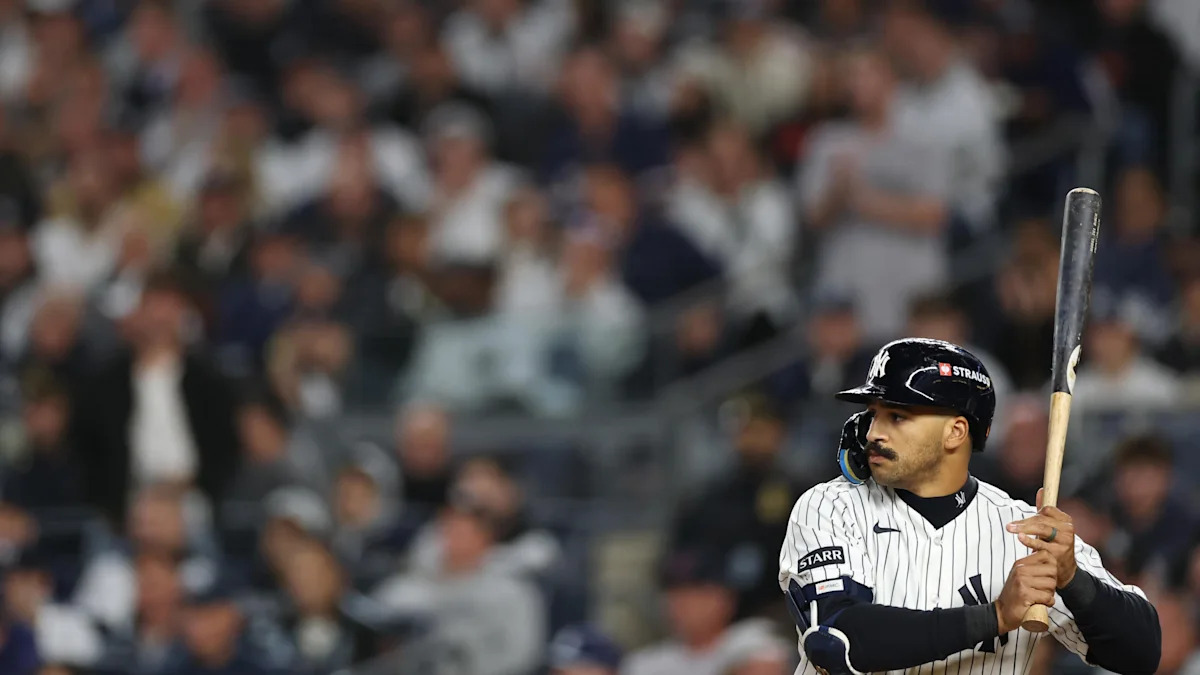
Batting order alone doesn’t dictate a team’s fortune, but it does make a difference. This is especially so in short series, where even the tiniest edges and flaws are magnified. And no place in the lineup matters more than the top spot. Suffice it to say that Aaron Boone and the Yankees faced an extremely important decision when choosing the leadoff man for Game 3 with the season on the line.
So why in the world did they land on Trent Grisham?
Advertisement
To state the obvious, Grisham did not have a good year in any shape or form. He had a .308 OBP. His wRC+ was 98. And these numbers are what he recorded before landing on the IL at the start of September with a strained hammy. To his credit, Grisham did record two hits during the party against the dregs of the Red Sox bullpen in Game 2 of the Wild Card Series, but he was a non-factor in Games 1 and 2 of the Division Series. This isn’t the resume of someone to whom you’d like to entrust the leadoff spot in an elimination game . And yet, that’s precisely what the Yankees did.
Of course, it’s easy as an armchair manager to fall into the trap of hindsight. It would be wrong of me to point to Grisham’s 0-for-5, three-strikeout night and say, “I told you so.” But that’s not what I’m going to argue. My point is that hitting Grisham first was the wrong call, even if it had worked out, because the decision-making process had a fatal flaw — one that explains so much about this current era of Yankees baseball.
That flaw is this: the Yankees’ way of evaluating players has become far too rigid. Once they make up their mind about a player’s true talent, they will adhere to it adamantly, even if the on-field results suggest that something is wrong. It takes a mountain of evidence to pile up for them to consider recalibrating their view of that player, and by the time that happens, the damage has already been done.
Trent Grisham is but the latest example. When asked postgame whether he regretted placing Grisham in the leadoff spot, Aaron Boone had this to offer:
“No. I mean, look, obviously, we really struggled to score runs in the first two games, and I was pretty convicted on trying to find a way to be able to get Benny a chance to come up with runners on or be in a position to do that more often tonight…it’s a decision I made to try and create a little bit of traffic, and obviously it didn’t work. But you’re going to live with that.”
I get wanting to give Ben Rice more chances to hit with men on base. But even if that made sense, Grisham was not the answer. The man isn’t a high-OBP guy. Not counting 2020, his career high over a full season is the .348 mark he posted last year; in all other years he’s failed to reach .330. He’s a high-walk guy, I’ll give him that, but his abysmal batting averages have generally dragged his OBP down to unremarkable levels. To wit: Grisham’s career walk rate is a robust 12.1 percent, but his career OBP is a pedestrian .319.
Advertisement
Boone’s reasoning only makes sense if you assume that Grisham’s superb 2025 represented a new baseline for him, and that version of him was still somewhere within him, despite his subpar 2026 numbers and his late-season injury. It seems, in short, that Boone and the Yankees were clinging to the best version of Grisham in their minds, a version detached from reality.
When viewed in this way, the Grisham decision turns from an isolated blunder to the latest case of a widespread issue. Recall how the Yankees kept running Austin Wells out until June, despite him hitting for a 26 wRC+ for the entire month of May. The team only took action when Wells went to them, suggesting that they might have been unaware that something was ailing Wells if he hadn’t.
I don’t think it’s too farfetched to theorize that they viewed Wells’ disastrous offensive performance as merely a bad slump, and that they were planning on simply running him out there until he experienced positive regression, without making any inquiries into his health. The Yankees had an idea of how Austin Wells was supposed to hit, and when the on-field results weren’t there, they assumed that their idea of Wells would eventually translate to reality, rather than readjusting their evaluation of Wells given recent results.
Wells’ case is reminiscent of how the Yankees handled Anthony Rizzo’s concussion in 2023. It took 46 games of Rizzo hitting .172/.271/.225 for the Yankees to do anything, and even then, Rizzo had to go to the team, not the other way around. And this goes beyond how the Yankees have mismanaged injuries; in 2024, we saw them keep trotting out Alex Verdugo in left field when it was clear by mid-July that it wasn’t working out. In 2025, they stubbornly kept on using Devin Williams in high-leverage situations, a crucial factor in them losing the division race. Then there’s the ongoing shortstop question, with the Yankees being stubborn at various points about both Isiah Kiner-Falefa and Anthony Volpe’s abilities. Time and time again, the Yankees of recent years have shown a reluctance to change their minds about their own players.
Advertisement
Admittedly, there is something to be said for not overreacting to small sample sizes. Even superstars can have bad weeks and months; look at how Pete Crow-Armstrong and Fernando Tatis Jr. started their respective years, compared to the numbers they finished with. Closer to home in 2024, Aaron Judge followed an awful April with a preposterous .352/.488/.777 triple slash with 52 homers in 127 games as he won MVP. Making rash, drastic changes based on the tiniest fluctuations in performance is not a winning formula by any means.
However, there needs to be a balance. Teams can, and should, try to constantly update their understanding of players’ abilities based on new data, while keeping in mind that small sample size caveats apply. Right now, the Yankees’ modus operandi appears as though it’s set in stone. If that’s due to a philosophical stance about trying not to be influenced by granular data points, then that stance needs to be relaxed. And if that’s due to complacency and hubris, then I’d like to remind them that it’s been 17 years since their last title. Something needs to change.
Join the conversation!
Sign up for a user account and get:
Advertisement
-
Comment on articles, community posts
-
Rec comments, community posts
-
New, improved notifications system!

