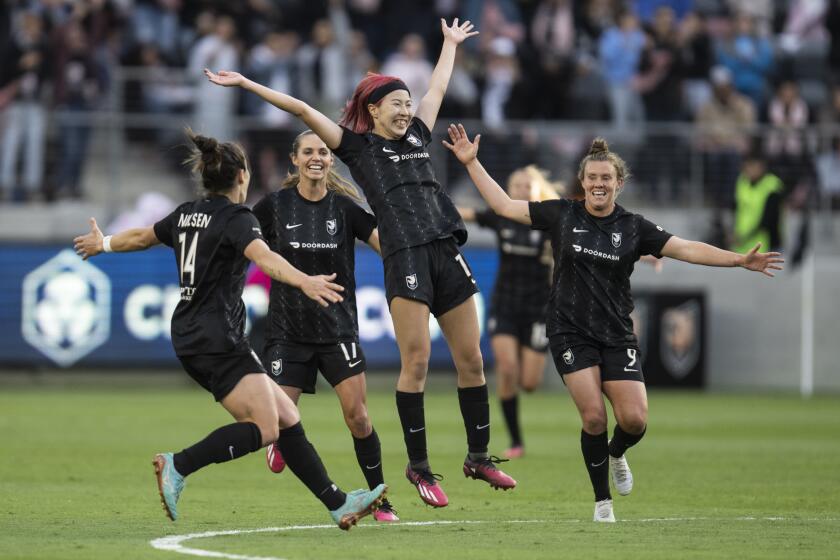
Growing up Japanese American in Southern California, Saki Watanabe had plenty of role models who showed her she could be whatever she wanted to be. There were baseball players, judges, politicians and actors. Writers, artists, teachers and business leaders.
But there was nobody doing what she wanted to do, which was play soccer.
Advertisement
“I did wish there were other players like me,” said Watanabe, a former college player who now works for Angel City’s community team and coaches with the Los Angeles Bulls soccer club. “I didn’t have a player that I looked up to.”
Or, more to the point, one that looked like her. So the message she took away was there was no place in soccer for Japanese girls.
That’s no longer the case. When Angel City entered the NWSL in 2022, Jun Endo, a Japanese international, was in the starting lineup for the team’s first league game and scored the second NWSL goal in franchise history. Angel City now has three Japanese players on its roster, most in the league, while the Galaxy won the MLS Cup last winter with two Japanese playing key roles.
Read more: AV Alta finding quick success, and strong fan support, in its inaugural season
Advertisement
“That’s a really cool thing that’s happening,” said Thomas Honda as his young daughter, clad in an oversized Galaxy jersey, excitedly asked defenders Miki Yamane and Maya Yoshida for autographs after a preseason game earlier this year. The girls’ grandmother, standing nearby, chatted the men up in Japanese.
“I really hope that one day she kind of runs with it and it’s like ‘hey I could be like them’,” continued Honda, the Galaxy’s finance director. “For my daughter that’s even more relatable, having the Japanese representation.”
And the importance of that example is not lost on the players. As the Dodgers’ Shohei Ohtani has taken the profile of Japanese athletes to dizzying heights in Southern California, that’s created an opening for soccer players to stand up and stand out as well.
“It’s a responsibility to be in a position where people, they feel inspired. They look up to professional players and so being in a position where I can become that inspiration, I’m very lucky to be in that position,” Angel City defender Miyabi Moriya, a World Cup and Olympic veteran, said through Watanabe’s translation. “It feels empowering to be in that position to influence Japanese players in the U.S. to play soccer.”
Advertisement
Yoshida, who led MLS in minutes played last season while captaining the Galaxy to a championship, agreed.
“That’s very important, to keep our reputation not only as a soccer player but as Japanese,” he said. “All my behavior is linked to representing Japan. I understand I should try to be nice and be the one everyone should be proud of.”
Galaxy defender and team captain Maya Yoshida lifts the MLS Cup after the team’s championship win over the New York Red Bulls in December. (Allen J. Schaben / Los Angeles Times)
The first Japanese soccer player to feature for an L.A. team was defender Akira Kaji, who joined Chivas USA halfway through its final season and made 14 starts. But Endo, a free spirit who was one of Angel City first international signings in 2021, was the first truly influential Japanese player in Southern California. Her tireless work rate, bubbly personality and a penchant for dyeing her hair different pastel colors made her one of the team’s most popular players in the team’s inaugural season.
Advertisement
“In our first year, I could find you pictures of men with pink hair because of Jun,” said Lisa Milner Goldberg, Angel City’s vice-president for public relations.
And even though a torn ACL has kept Endo off the field the last two seasons, that popularity hasn’t ebbed.
“More Japanese fans come out and they’ll reach out to me in Japanese postgame, which didn’t happen as much in my first year,” Endo said in Japanese. “There have also been kids and fans trying to learn Japanese and trying to speak to me.”
Endo said she’s long embraced the idea that athletes, simply by their example, can let children know they are welcome in certain spaces. That’s the example that was denied to Watanabe growing up.
Advertisement
“When I was a kid I had that feeling of if I can see it, I can do it. Not necessarily in the sense of gender or culture. But just in certain aspects of soccer and the individual player,” Endo said. “That’s how I gained confidence. Now I want to inspire kids because I love being a role model.”
Read more: How Koreatown seniors have become Kings’ playoff good luck charm with harmonica national anthem
Yamane, whose English remains a work in progress in his second season in MLS, said he has seen first-hand the impact the Japanese players are having in some parts of the community. He said he has a Japanese neighbor who wasn’t really interested in soccer until Yamane and Yoshida joined the Galaxy.
“He came to a Galaxy game because I played,” Yamane said. “Now he plays soccer with his daughter.”
Advertisement
The two Galaxy defenders and the three women players have had different fortunes this season. Angel City, which missed the playoffs last season, is 2-2-2 while the Galaxy (0-7-3) is winless through 10 games after Sunday’s 4-2 loss to Portland. It’s the worst start ever for a reigning MLS champion.
But they have gathered for dinner several times — always at a Japanese restaurant, said Angel City goalkeeper Hannah Stambaugh, the Tokyo-born daughter of an American serviceman and a Japanese mother.
“American dishes are amazing,” Stambaugh said in heavily accented English. “But sometimes we miss Japanese food.”
The meetings are more than just a chance for a good meal though.
Advertisement
“They’re talking about creating something,” Watanabe said. “In L.A., it’s a pretty decently big Japanese community. And they have Hollywood, which is all about creativity. So they want to create something that brings the Japanese community together.”
They already have.
⚽ You have read the latest installment of On Soccer with Kevin Baxter. The weekly column takes you behind the scenes and shines a spotlight on unique stories. Listen to Baxter on this week’s episode of the “Corner of the Galaxy” podcast.
This story originally appeared in Los Angeles Times.

