“Gentleman. American. Sportsman. Through whose vision and courage this imposing edifice, destined to become the home of champions, was erected and dedicated to the American game of baseball.”
So reads the second plaque erected at the old Yankee Stadium to recognize a figure of organizational significance. The plaque predates Monument Park itself, having been installed upon the center field bleacher fence in 1940, the year after the death of the man it honors.
While the ballpark was informally christened “The House that Ruth Built,” of course the Yankees’ ownership was directly responsible for its construction. The plaque in question honors Jacob Ruppert, the renaissance man who owned the Yankees for 24 years. He’s received the lion’s share of the credit for shepherding the Yankees’ franchise from afterthought to behemoth, with Yankee Stadium serving as the physical embodiment of this ascent.
Advertisement
But it was not Ruppert who oversaw construction at East 161st Street and River Avenue. It was his co-owner, a civil engineer by trade whose attention to detail led him to spend two weeks deciding on the perfect seats for the grandstand and whose legacy as one of the most pivotal figures in Yankees history has been largely papered over.
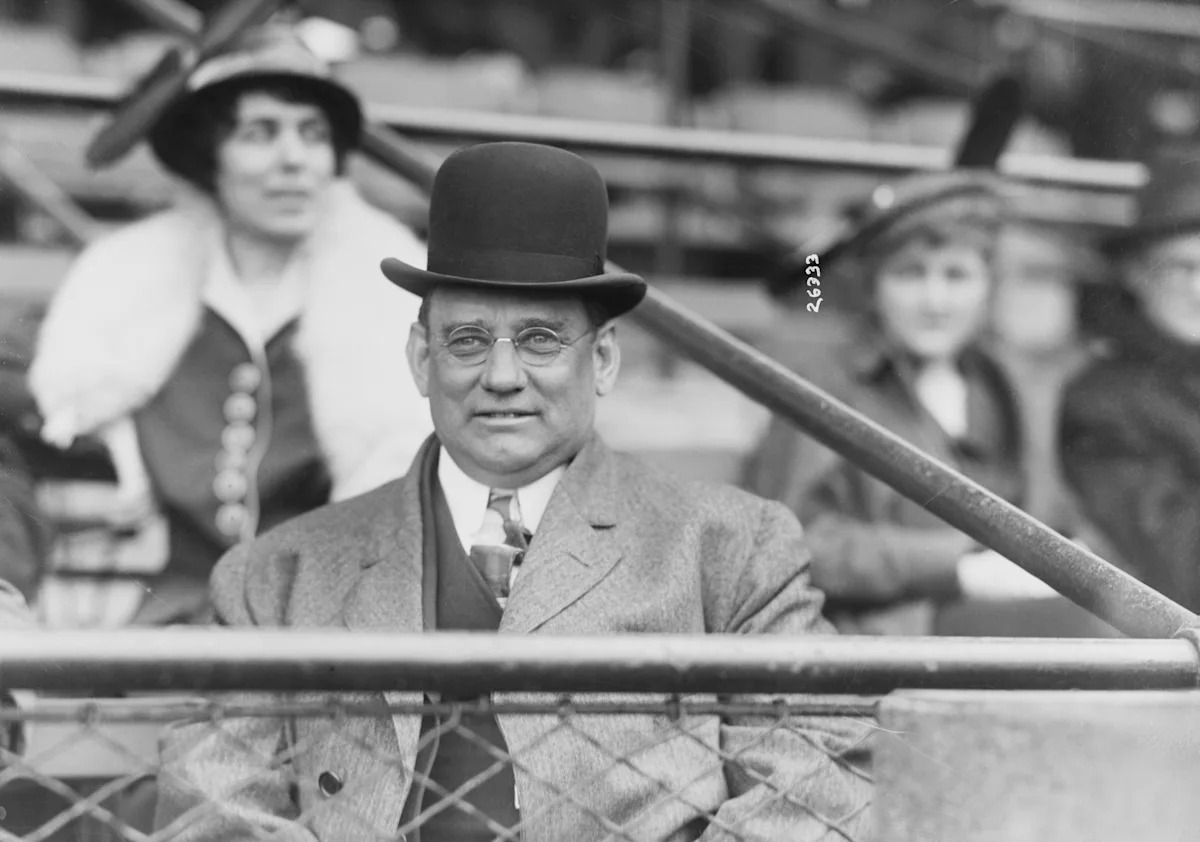
Tillinghast L’Hommedieu Huston
Born: July 17, 1867 (Buffalo, NY)
Died: March 29, 1938 (Darien, GA)
Yankees Tenure: 1914-23 (co-owner)
Tillinghast L’Hommedieu Huston grew up in Cincinnati, Ohio as a diehard Reds fan. He followed in the footsteps of his father, a civil engineer from Ireland, with the two working together on the Louisville and Nashville railroads. The younger Huston joined the Army during the Spanish American War, serving as a captain in the 16th Regiment of Engineers in Cuba. He stuck around for 15 years after hostilities ended, building his fortune developing infrastructure for the fledgling nation.
Despite his physical distance from his homeland, Huston remained connected to the game he loved as a child, getting American newspapers so he could follow box scores. “Neither tropic heat nor tropic rain could drive thoughts of the old game from my head,” he’d say years later of this period.
Advertisement
Upon his return, he hatched a plan to purchase the Chicago Cubs in 1914 and install his good friend John McGraw as manager. While McGraw was keen on the idea, he had to back out after being unable to withdraw from his contract with the Giants. A few months later, Huston linked up with Ruppert to purchase a moribund Yankees franchise. The two split the roughly $460,000 cost evenly, with Ruppert serving as team president and Huston as secretary and treasurer.
Turning the Yankees around would be no small task. The new co-owners employed a strategy familiar to more recent owners of the club: spend early and often. Ruppert and Huston reportedly told their staff to “go to the limit” in procuring talent, later relaying to manager Bill Donovan that “no sum of money would stand in the way” of whatever acquisitions he requested. Their resulting bounty, which included Hall of Famer Home Run Baker and Bob Shawkey, who’d win 168 games in 13 years in New York, served notice to the rest of the league and helped the Yankees start climbing up in the standings.
The crowning achievement of this talent influx came in December 1919. Fresh off their best finish since they were known as the Highlanders in 1910, the Yankees purchased Babe Ruth’s contract from the Red Sox. By 2021, they’d be playing in their first World Series.
Throughout this period, there was one snag in the Yankees’ rise. Since 1913, they had had played second fiddle at the Giants’ Polo Grounds in Manhattan. As the Yankees’ fortunes improved, they began to wear out their welcome. The Giants first attempted to evict them, then settled on vastly increasing their rent. Huston, leveraging his civil engineering background, led the search for a new site, surveying plots of land across Manhattan, Queens, and the Bronx. He and Ruppert settled on a 10-acre plot of land just across the Macombs Dam Bridge from the Polo Grounds in the Bronx.

Work began in 1922, with Huston a regular presence at the site. As construction drew to a close, he expressed his desire to sell his half of the club to Ruppert. “I’m old and tired,” he said of the decision. “The Yankees are a good team and the stadium is nearly finished. It looks as if my work is about done.” In reality, the move to sell was also sparked by years of tension between the two co-owners, chiefly over the hiring of eventual Hall of Famer Miller Huggins as manager.
Advertisement
Huston sold his stake in the team in May 1923, weeks after his beloved stadium first opened its doors. He left the team he helped purchase less than 10 years earlier with a new ballpark of its own and on the doorstep of its first of 27 world championships and counting. Huston moved to Georgia after his retirement from baseball before making one last attempt to buy back in. In the mid-1930s, he made an offer to purchase the Brooklyn Dodgers with a plan to install Ruth as manager, though his bid was not accepted.
Huston died of natural causes in Darien, GA at the age of 70. Unlike Ruppert, he has yet to receive enshrinement in the National Baseball Hall of Fame or much of a formal acknowledgement at the stadium he helped built. But through the conviviality, connections, expertise, and purse he brought to the New York Yankees, he deserves no less credit for the team’s historic turnaround.
See more of the “Yankees Birthday of the Day” series here.

