March Madness is finally here and the stage is set for this season’s superstars to etch their names into NCAA tournament lore.
Does this year’s tourney have an Ali Farokhmanesh or a Harold Arceneaux in its midst? How about a Bryce Drew or even, dare we say … a Stephen Curry? All it takes is one freak performance or a buzzer-beater to become a legend in March Madness.
Advertisement
Our region-by-region breakdowns highlight Cinderellas to watch and all of our predictions for the tournament can be found right here. Who are the players to watch in the bracket over the coming weeks? We’ve got you covered there too.
Yahoo Fantasy Bracket Mayhem: Make your picks for $50K in total prizes
NCAA tournament players to watch
East region
Duke forward Cameron Boozer
If Duke does advance to the Final Four and beyond, it will be on the back of Boozer, the leading candidate for National Player of the Year honors from a stacked field. Boozer has done nothing but exceed the expectations that he arrived with at Duke as the team’s leader on the court and in the box score.
Advertisement
The do-it-all 6-foot-9 forward is averaging 22.5 points, 10.2 rebounds, 4.2 assists and 1.5 steals per game while shooting 56.5% from the field and 40.9% from 3. He’s an inside-out threat who projects conservatively as a top-five NBA Draft pick.
With Foster and potentially Ngongba set to miss more time, the load will be that much heavier on Boozer in the NCAA tournament.
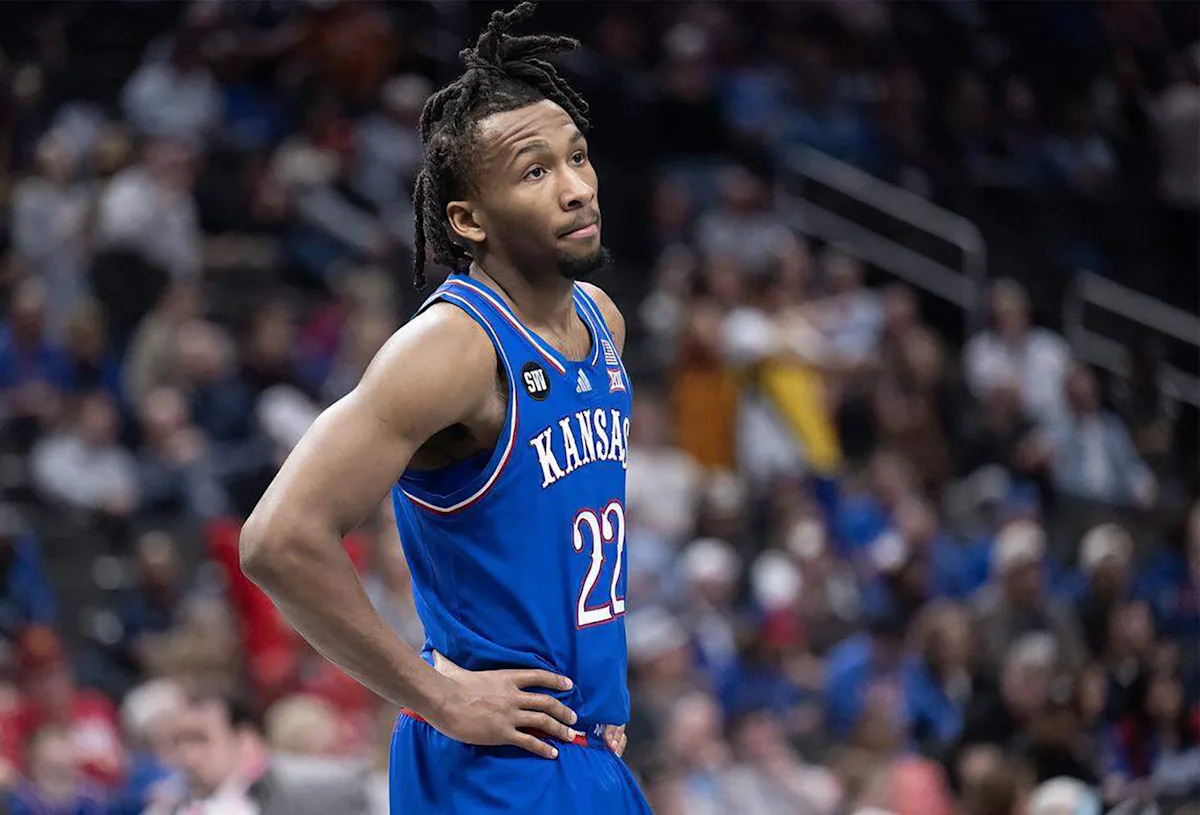
Will Kansas guard Darryn Peterson show out or be a no-show in the NCAA tournament? (Tammy Ljungblad/Getty Images)
(Kansas City Star via Getty Images)
Kansas guard Darryn Peterson
Peterson is arguably the most important player to his team in the tournament. How he goes dictates how Kansas goes, which could mean a first-round upset or a trip to the Final Four and beyond.
Peterson is an elite talent who started the season as the consensus No. 1 pick in June’s NBA Draft. An up-and-down campaign has tempered that excitement, but Peterson is a lock to go high in the lottery if not still No. 1 overall.
Advertisement
There’s little question about his basketball ability, and he’s flashed it this season with averages of 19.8 points, 4.4 rebounds and 1.5 steals per game while shooting 38.4% from 3. His overall efficiency has been less than elite (44.2% from the floor, 58.8 true shooting%) and his availability has become a liability.
Peterson has missed 11 of Kansas’ 33 games and failed to finish others with uncertainty around exactly why he’s missed time. If he’s available and on his game, Kansas is dangerous. Anything short of that spells trouble for the Jayhawks.
Michigan State guard Jeremy Fears Jr.
Jeremy Fears is the heart and soul of Michigan State’s roster, for better or worse. A fiery competitor with talent to match, Fears was a first-team All-Big Ten selection who has averaged 15.7 points and a league-high 9.2 assists this season.
Advertisement
He’s an extension of Izzo on the floor who sets the tone for Michigan State’s methodical and efficient halfcourt attack.
He also has a penchant for losing his composure and engaging in non-basketball behavior that gets him T’d up. If he can stay on the floor and under control, Michigan State will be a tough out.
South region
Houston guard Kingston Flemings
Houston returns starters Emanuel Sharp, Joseph Tugler and Milos Uzan from last season’s national runner-up team. None of them are the best player on Houston’s roster. Flemings is an explosive 6-foot-4 scoring point guard who’s taken the lead role on a veteran roster with Final Four experience.
Advertisement
A projected top-five NBA Draft pick, Flemings leads Houston with 16.4 points, 5.3 assists and 1.6 steals per game. He’s a three-level scorer who attacks the rim with ferocity and shoots 39.2% from 3. He could be the difference from last year’s team that lost in the national championship game and this year’s team in winning one.
Illinois guard Keaton Wagler
Alongside Flemings, Wagler is another explosive scorer from this season’s phenomenal NCAA freshman class who could hear his named called in the lottery of June’s NBA Draft. A lights-out shooter with a 6-6 frame who can also finish at the basket, Wagler is a first-team All Big Ten selection and the biggest reason Illinois earned a No. 3 seed.
Wagler averaged 17.9 points, 4.8 rebounds and 4.6 assist per game while shooting 40.2% on 5.8 3-point attempts per game. He set Illinois’ freshman scoring record and is capable of taking over any game he plays in. Just ask No. 2 seed Purdue, which was on the wrong end of a 46-point effort from Wagler in which he shot 9 of 11 from 3.
Advertisement
Florida forward Thomas Haugh
Haugh has evolved from a valuable sixth man from Florida’s championship roster to a first-team All-SEC forward and the Gators’ No. 1 option. Haugh moved into the starting lineup this season as a junior and enters the NCAA tournament averaging a team-high 17.1 points alongside 6.2 rebounds, 2 assists and 1.1 steals per game.
He’s developed into a first-round NBA prospect in the process. If Florida advances to a second consecutive Final Four, Haugh will be a big reason why.
West region
Arizona guard Brayden Burries
We could pick multiple Wildcats here; that’s how deep Arizona’s starting lineup is. Senior Jaden Bradley hit the game-winning buzzer beater against Iowa State in the semifinals of the Big 12 tournament. Freshman forward Koa Peat had 21 points in the Wildcats’ win over Houston in the title game.
Advertisement
But we’ll go with another freshman here in Burries. He also scored 21 in the win over Houston as he shot 60% from the field and made all seven of his free throws. That came after Burries had 21 against UCF in the tournament opener and 31 against Colorado to end the regular season.
The guard is Arizona’s leading scorer and also grabs nearly five rebounds a game while shooting 37% from behind the arc. Burries is a potential top-10 pick in the 2026 NBA Draft if he chooses to turn pro.
Purdue guard Braden Smith
Smith should break a longstanding men’s basketball record in the Boilermakers’ first-round game against Queens. After dropping 11 assists in Purdue’s Big Ten tournament title game win over Michigan, Smith needs just two assists to break Bobby Hurley’s record for career assists.
Advertisement
Hurley had 1,076 assists from 1990 through 1993 at Duke. Smith now sits at 1,075. He’s averaging nine assists and 14 points a game in 2025-26 after scoring nearly 16 points a game and averaging 8.7 assists a season ago.
Purdue might have discovered something in the Big Ten tournament, too. The No. 1 team in the preseason AP Top 25 entered the conference tournament with four losses in its last six regular season games. In Chicago, the Boilermakers won all four of their games by multiple possessions and Smith had a whopping 46 assists in those games.
Gonzaga forward Graham Ike
The West Coast Conference player of the year has averaged over 10 points a game in all five of his college basketball seasons. This season, Ike is averaging 19.7 points per game while shooting 57% from the field.
Advertisement
Believe it or not, that’s his worst shooting percentage as a Zag. In his first season after transferring from Wyoming, Ike shot 61% from the floor. A season ago, he was at just under 60%. This year, he’s upped his 3-point attempts (he’s shooting 35% from beyond the arc) and is also shooting more than two additional shots per game than he did in either of his first two seasons in Spokane.
Midwest region
Michigan forward Yaxel Lendeborg
The UAB transfer has been one of the best players in college basketball this season. Lendeborg shoots 51% from the field as he averages 14.4 points and seven rebounds per game. He scored 20 points in the Wolverines’ Big Ten tournament championship game loss to Purdue and dropped 27 while making 67% of his shots in the last game of the regular season against Michigan State.
Advertisement
Michigan’s size is a mismatch for most opponents as the frontcourt trio of Lindeborg, Morez Johnson and Aday Mara average nearly 30 points and over 20 rebounds a game. Can anyone slow the Wolverines’ big men down before the second weekend of the tournament?
Iowa State forward Milan Momcilovic
The junior has been absolutely absurd from behind the arc this season. Momcilovic leads Iowa State with 17.1 points per game and is shooting 51% from the field. But less than half of his shots come inside the 3-point line.
Momcilovic is shooting almost 50% from the 3-point line on 7.5 attempts per game this season. His attempts from behind the arc make up basically two-thirds of his overall shot attempts — he’s shooting 55% from 2-point range — and may be the best volume shooter from long range in college basketball.
Advertisement
That was on full display in the Cyclones’ Big 12 tournament semifinal loss to Arizona on Friday. Momcilovic was 8-of-14 from the 3-point line and 10-of-18 from the field as he had 28 points in the 82-80 defeat.
Virginia forward Ugonna Onyenso
There’s an extremely good reason we are highlighting a player who is averaging 6.7 points and five rebounds a game in this section.
Onyenso was an absolute eraser in the lane during the ACC tournament and can be the type of defender that anchors a deep tournament run. He set the ACC tournament record with 21 blocks across three games — that is not a typo — and broke the previous record by 50 percent.
Advertisement
In the Cavaliers’ ACC title-game loss to Duke, Onyenso scored just six points but had eight rebounds and nine blocks. That came just two days after he had eight blocks in a win over NC State. He slacked off in the semifinal win against Miami with four blocks but had 17 points as the Cavaliers won by 22. The Nigeria native played at Kentucky and Kansas State before transferring to Virginia this season and could be earning a serious look by NBA teams with the way he can swat shots. Perhaps most impressively, Onyenso accompanied those 21 blocks with just three fouls.

