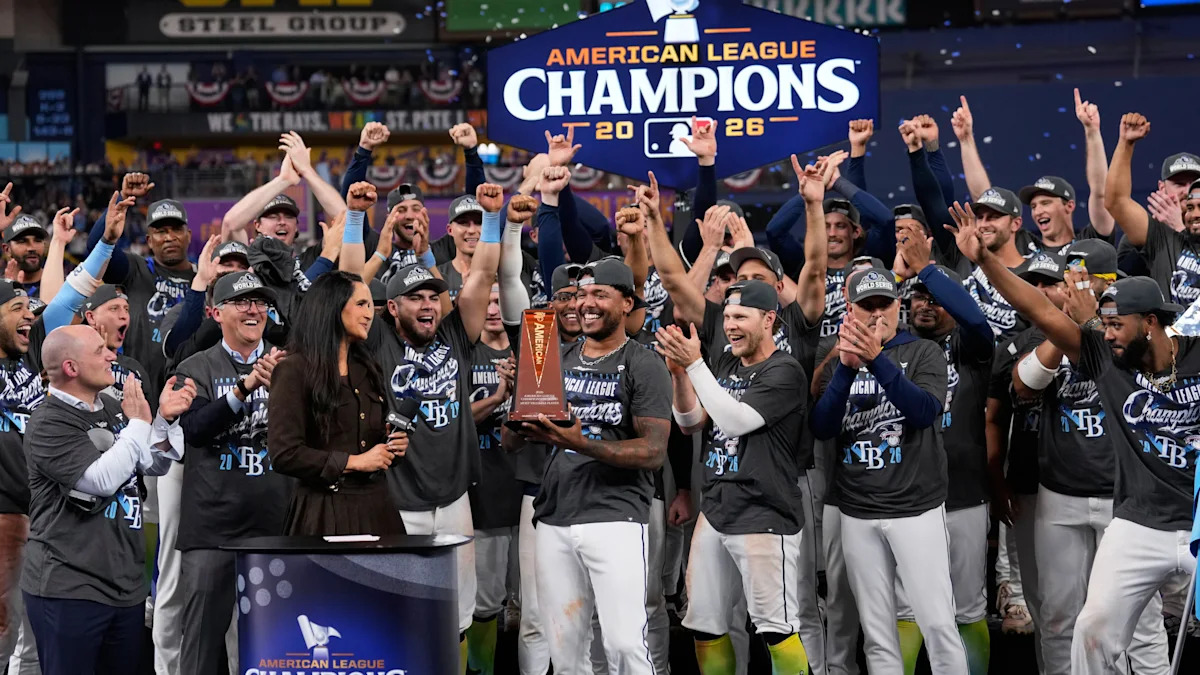
For the first time in four-and-a-half decades, the 2026 World Series is guaranteed to result in a first-time champion. It could very well be the American League champion Tampa Bay Rays.
After a six-game win over the Cleveland Guardians in the ALCS, the Rays are set to face the NL champion Milwaukee Brewers in the Fall Classic. It is the first time since the 1980 World Series between the Philadelphia Phillies and Kansas City Royals that two teams without titles have faced each other.
Advertisement
Game 1 is scheduled for 8 p.m. ET Friday in Milwaukee.
The World Series features two undeniably small-market teams, but both have been punching above their weight class for years. We already talked about how the Brewers have done this, so let’s dive into how the Rays operate.
They are the classic small-payroll, big-brain team
No team in MLB exemplifies the sort of club that overcomes a lack of payroll with smart decisions like the Rays. They are the shorthand for that archetype, and 2026 has become a strong example of why.
The Rays rank 28th in MLB payroll this season, at $90 million, per RosterResource. They are the third-cheapest team in MLB, ahead of only their ALCS foe Guardians ($87 million) and the Miami Marlins ($76 million). Even the Brewers are well ahead of the Rays at 19th ($142 million).
Advertisement
Whichever team wins will be the cheapest World Series champion since at least the 2017 Houston Astros (cue snickering), but the Rays would introduce an entirely different degree of rarity. Going off data from Cot’s Contracts, the last World Series winner with a sub-$100 million year-end 40-man payroll was the 2006 St. Louis Cardinals at $91 million, which ranked 10th in MLB at the time.
This entire decade has seemingly operated on the rule that you need a big payroll to win a title. The Rays would completely undercut that.
This is their third chance at a first World Series
Unlike the Brewers, who are returning to the World Series for the first time since 1982, the Rays aren’t decades removed from the World Series.
Advertisement
Tampa Bay has reached the Fall Classic twice, in 2008 and 2020. It lost the former to the Philadelphia Phillies and the latter to the Los Angeles Dodgers.
This current Rays roster doesn’t bring much experience from those series. On the Rays’ ALCS roster, only designated hitter Yandy Díaz was part of that 2020 team. The rest of the team has completely turned over (save for injured ace Shane McClanahan).
They’ve been doing this for a long time
MLB fans over 30 likely remember a time when the expansion team in Tampa Bay was a laughingstock, trapped in a division featuring the New York Yankees and Boston Red Sox. The Rays began their existence with nine last-place finishes in 10 years, with the only exception being a fourth-place finish in 2004. Their first World Series appearance in 2008 also happened to be their first winning season.
Advertisement
The moment everything changed can be traced back to 2003, when team owner Stuart Sternberg met a college baseball player-turned-finance guy by the name of Andrew Friedman. By 2005, Friedman was general manager and leading the front office to a new frontier of analytics. Friedman left Tampa Bay in 2014 to do something similar with vastly more resources for the Los Angeles Dodgers, but the Rays have kept plugging on without him under current president of baseball operations Erik Neander.
Like an NFL coaching tree, so many successful GMs in today’s game can trace their lineage back to the Rays under Friedman and Neander. That includes Brewers president of baseball operations Matt Arnold, who worked under Friedman in Tampa from 2007 until his departure in 2015.
It can’t be denied that Tampa Bay’s fortunes have ebbed and flowed under this direction — the team won only 77 games last year — but few teams have been better at staying one step ahead of the competition from an ideas perspective. For the Rays, that’s a matter of survival.
As for the manager side, Kevin Cash is MLB’s longest-tenured manager, having taken over the dugout in 2015 in the aftermath of Friedman’s departure (which triggered manager Joe Maddon’s departure). Clearly, the front office appreciates his ability to implement its ideas.
Advertisement
They’ve been the AL’s best team all season
In a chaotic AL season featuring division champions with 85 wins and 81 wins, the Rays stood out as the league’s only truly elite team at 98-64. That has borne out in the playoffs as well.
A fun quirk of the MLB playoff structure meant the Rays had to start their postseason against the AL’s second-winningest team, the 93-win New York Yankees. They swept them in the ALDS. Then came the Guardians, who at least made it a series at 2-2 before the Rays pulled away in Games 5 and 6.
As is the case with the Brewers, it really shouldn’t be a surprise that Tampa Bay is here. This is a true No. 1 vs. No. 1 matchup.
They don’t strike out
It’s a common criticism of modern baseball that hitters strike out too much, though much of that can be blamed on the unreasonable challenge of facing modern pitching velocity.
Advertisement
Consider the Rays a throwback in this regard. No team in MLB struck out at a lower clip than Tampa Bay at 18.8%, which helped the club post the best batting average in the AL at .258.
Not a single member of this team struck out more than 25% in the regular season (min. 200 plate appearances). By comparison, the Brewers have four such players. The Rays prioritize making contact, even if it’s not always good contact, as they ranked third-lowest in both hard-hit rate and line-drive rate during the regular season, per FanGraphs.
That makes for an interesting comparison with the Brewers, who swing less than any team in MLB and led the league in walk rate. The Rays actually rank in the middle of the pack when it comes to how much they swing, but no team in MLB makes contact more frequently when they do swing.
Neither approach leads to a ton of home runs — the Rays ranked 22nd in MLB this season, the Brewers tied for 28th — but it speaks to how intentionally these two teams have been crafted. Both are the best in the sport when it comes to two very important components of hitting: making contact and patience at the plate.
Advertisement
Their big 3 hitters have come up huge
Not many people are going to be describing Díaz, Jonathan Aranda and Junior Caminero as the faces of MLB, but those three have formed Tampa Bay’s offensive backbone this season. And all three had big moments in the ALCS.
Díaz has long been an ultra-patient hitter, and he led the AL in hits this season. He has flexed his muscle in the postseason with six extra-base hits, one of them a game-sealing homer in Game 6 against the Guardians.
Aranda broke out as an All-Star last year but went hitless in his first 11 ALCS at-bats. However, he either hit or scored on the three biggest plays of Game 4, which swung the series back in the Rays’ favor.
Advertisement
Caminero was a homer short of leading the AL this season, with 42 to Pete Alonso’s 43. The former elite prospect swings the bat harder than any player in baseball but still keeps the strikeouts under control, a rarity among modern power hitters. He was homerless for the entire postseason until Game 6, when he posted the longest home run trot on record in MLB postseason history.
The Rays’ offense is actually pretty simple. Their first baseman, third baseman and designated hitter provide the wood. Everyone else can be counted on to at least deliver two-way value.
Their defense is elite among elite
The effectiveness of team defense is often conveyed by number of errors or Gold Gloves, but ultimately, it comes down to how good a team is at turning balls in play into outs. That’s what defensive efficiency measures, and the Rays are the best in the league.
Advertisement
The Rays’ outfield — led by Jonny DeLuca, Chandler Simpson and Victor Mesa Jr. — led MLB in outs above average this season. Shortstop Taylor Walls is a Gold Glove finalist and the favorite to win the award. Ben Williamson can play any position in the infield well.
Between that group and the big three hitters, odds are that every Rays position player is going to be very good to elite in at least one important thing. That includes baserunning.
Chandler Simpson must be discussed
Since he made his MLB debut last season, no player has more stolen bases than Simpson’s 90. To be fair, no player has been caught stealing more times than his 26, but he’s 3-for-3 this postseason, and his speed on the basepaths has definitely factored into games.
Simpson also led the AL in bunt hits, with teammates Cedric Mullins and Walls right behind him. Again, the Rays want to make contact, and they’re happy to use their speed to make up for any loss in power.
Advertisement
Funnily enough, it’s the Rays and Brewers who have embraced the bunt more than any other teams in MLB. The Rays led MLB in both bunt hits (49) and sacrifice bunts (45) this season, while the Brewers ranked second (32) and fifth (37) in those areas.
For all that’s made about bunting being anathema for the analytics-minded, these are two analytics-heavy teams trying to zig where the rest of the industry has zagged.
Freddy Peralta has been a huge pick-up
Former All-Star starter Shane McClanahan was shut down earlier this month due to forearm tightness. That’s a huge loss for the Rays, but the team has made do with a postseason rotation of Drew Rasmussen, Freddy Peralta, Nick Martinez and Griffin Jax.
Advertisement
Rasmussen is the staff ace, but Peralta has been just as important this postseason. The former Brewers pitcher was traded from Milwaukee to the New York Mets last offseason and was an outright disaster in Queens, posting a 4.99 ERA in 22 starts. He was sent to the Rays at the trade deadline and has since morphed back into a standout starting pitcher.
Peralta won AL Pitcher of the Month honors in September and has pitched in four straight wins for the Rays since the postseason began, with a 1.08 ERA. In the span of three months, he has salvaged a contract season.
How did the Rays do it? You can read more here, but the game plan includes ditching the wind-up and pitching out of the stretch, moving his foot placement on the rubber, throwing his changeup more and speeding up his delivery. That is a lot of changes, but the result has been a pitcher who is once again dominating with his fastball.
Their bullpen is looking a bit shallow
Unlike the Brewers, the Rays are willing to ride their starting pitcher into the later innings if possible. Part of that is a reflection of their strong rotation, but it might also be a sign of a bullpen that has only so many arms you can trust.
Advertisement
Bryan Baker is this team’s closer. Cam Booser has been brilliant from the left side this postseason. Tyler Wells and Ian Seymour were effective setup men during the regular season, but both had multiple ugly outings in the ALCS.
Beyond that group, no reliever has thrown more than three innings across Tampa Bay’s nine postseason games. The Rays went as far as using Peralta for two outs in relief in Game 4 of the ALCS.
That might be as close to a weakness as the Brewers are going to find with this Tampa Bay roster. The Rays can afford only so many short starts from their rotation, and they are facing a Milwaukee team that is the best in baseball at pestering starters out of the game, as we saw them do against the Los Angeles Dodgers in the NLCS.

