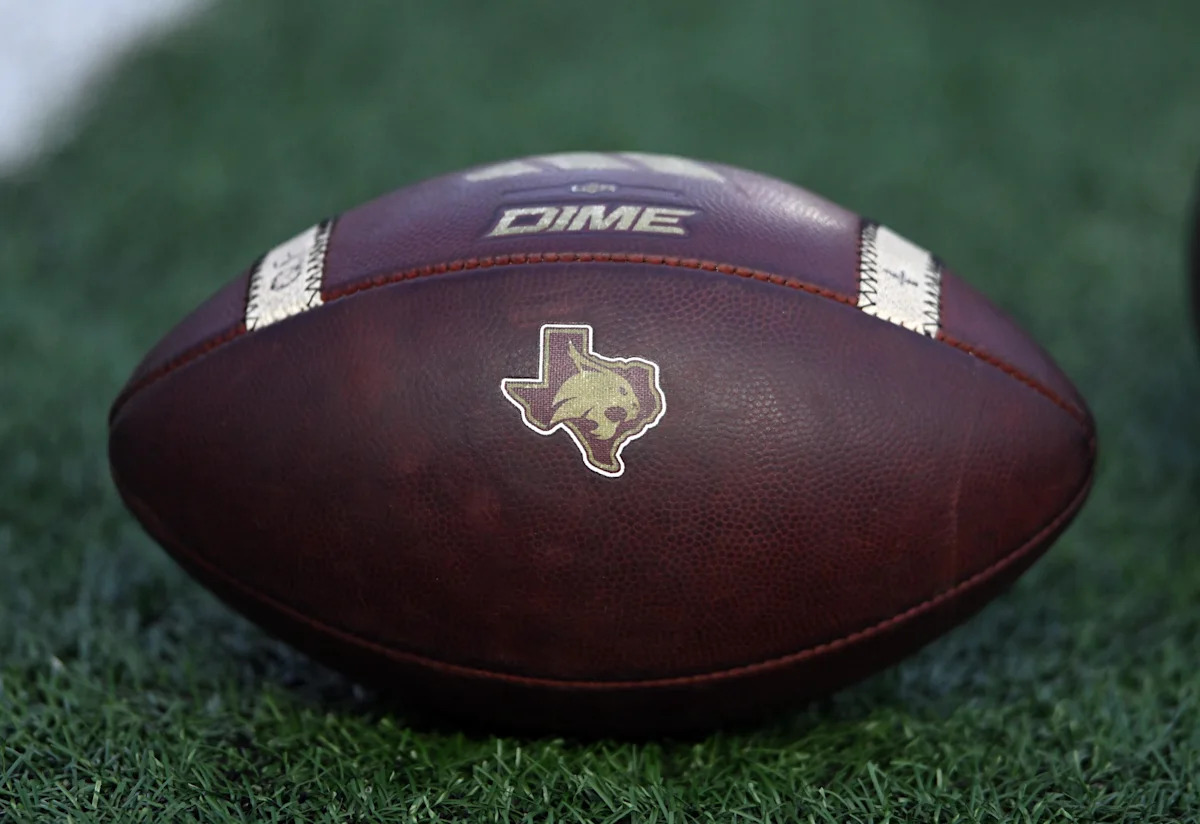
The Get to Know Your Foe series concludes with the latest addition to the Pac-12, the Texas State Bobcats.
Texas State University is located in San Marcos, Texas, and only fairly recently began playing football at the FBS level. Originally founded in 1899 as Southwest Texas State Normal School, the school offers over 200 degrees and was the alma mater for former U.S. President Lyndon B. Johnson. The school didn’t change its name to Texas State University until pretty recently. In 2003, the school became Texas State University-San Marcos with the expectation that other cities in the Texas State University system would also add their city names on the end. That didn’t end up happening, and 10 years later, the school dropped the San Marcos name and became Texas State University. Coincidentally, it also happened to be around the time Texas State became an FBS program in football.
Advertisement
But before the FBS was even a thing, the Bobcats were playing football dating all the way back to 1904. The school got their first taste of success in 1929, when they won the Texas Intercollegiate Athletic Association (TIAA) conference championship. The Bobcats operated as a College Division and Division II program for a majority of their history, spending most of it in the Lone Star Conference. That conference was formed in 1931 by Texas State, North Texas, Sam Houston State, East Texas A&M and Stephen F. Austin. Houston joined the conference briefly from 1945 to 1949.
The Bobcats won their first Lone Star conference title in 1948 under the direction of George Vest. They returned to the top of the conference in 1954 and 1955 under R.W. Parker. The team’s first undefeated season in the conference came in 1963 as Milton Jowers led the Bobcats to a perfect 10-0 record, going 6-0 in conference. The perfect season earned them the #9 spot in the final rankings. After 1963, the Lone Star conference became a part of the NAIA.
Following the 1980 season, the Bobcats and three other members of the Lone Star Conference moved up to NCAA Division II. This move ended up proving to be a launching pad for new coach Jim Wacker and the Bobcat program. In their final season at the NAIA level in 1980 and Wacker’s second season in charge, the Bobcats went 8-3 and won the Lone Star Conference. Now in Division II, the Bobcats took the entire division by storm, going 10-1 in the regular season, with the lone loss coming at the end of the year to Texas A&I 21-14. Despite the loss, the Bobcats still finished one game better than Texas A&I in the conference standings to secure another Lone Star championship. This time, however, their season didn’t just end in the regular season. The Bobcats were invited to the Division II playoffs as the #4 seed. They would host Jacksonville State in the first round and dispatched them 38-22. In the semifinals, they would host the #1-ranked Northern Michigan Wildcats. The Bobcats obliterated them, 62-0, to cruise to the championship against North Dakota State. Just like the previous two teams before them, North Dakota State stood no chance. Despite getting out to an early 7-0 lead, the Bobcats rallied and shut out NDSU in the second half for a 42-13 victory and claim the Division II National Championship in just their first season.
The Bobcats suffered no championship hangover in 1982. The Bobcats rolled through the regular season with a perfect 11-0 record, claiming another Lone Star title and another invite to the Division II playoffs. They would roll through Fort Valley State in the first round, 27-6, and just get by Jacksonville State in a rematch in the semi-finals, 19-14. In the championship game against UC Davis, the Bobcats cruised to a second straight national championship, beating them 34-9. Wacker would leave the Bobcats following the 1982 season to become the head coach at TCU. Wacker’s final record at Texas State was 42-8 with three conference championships and two national titles. He would return to San Marcos as the athletic director from 1998 to 2001. In his place, the Bobcats would hire John O’Hara, the former offensive coordinator at Baylor.
Advertisement
O’Hara had big shoes to fill but still managed the Bobcats to a modest 9-1 regular season, another Lone Star title, and a trip back to the playoffs. However, the Bobcats would get upset by Central State 24-16 in the opening round. After three years of dominating the Division II ranks, the Bobcats made the leap to Division I-AA (now FCS) and joined the newly formed Gulf Star conference. The Bobcats wouldn’t set the world on fire in their inaugural season like they did in Division II, going 7-4. The Gulf Star conference would last just three seasons before the Southland Conference would absorb four of the six teams.
The Bobcats wouldn’t see much success in the Division I-AA/FCS ranks until 2005. Between 1984 and 2005, the Bobcats had just four winning seasons. Led by David Bailiff, the Bobcats entered the season in the pre-season top 25 and started 2-0 with wins over Delta State and Southern Utah. They’d suffer their first loss to Texas A&M but played the Aggies tough, losing 44-31. They won four in a row following the loss before losing to rival Nicholls State in overtime, 32-29. The Bobcats would win their final three games of the season, including an overtime thriller in the regular-season finale, to secure their first Southland conference championship with an overall record of 9-2. They would receive their first invite to the Division I-AA playoffs, hosting the Georgia Southern Eagles in the first round. The Bobcats handled business, beating the Eagles 50-35. In the quarterfinals, the Bobcats would sneak past Cal Poly 14-7. Their semi-final game against Northern Iowa would be decided in overtime. After surrendering a field goal to Northern Iowa on the first possession, the Bobcats would throw a costly interception on third down to end the game and their season, 40-37. The Bobcats would return to earth the following year, going 5-6, and wouldn’t make it back to the playoffs until 2008, where they’d fall in the first round to Montana.
Following the 2010 season, it was announced that Texas State would be making the leap to the FBS level. They would play the 2011 season as an FCS independent, going 6-6. The 2012 season would be their first at the FBS level, joining the WAC for all of one season. In their inaugural game as an FBS team, the Bobcats traveled to Houston as large underdogs. The Bobcats would stun interstate rival Houston, winning the game outright 30-13. Their home opener wouldn’t go as well against Texas Tech, losing 58-10. The Bobcats would finish their first season at the FBS level at 4-8. They would also leave the WAC for the Sun Belt after just one season.
Texas State wouldn’t make their first bowl appearance as an FBS team until 2023 under current head coach G.J. Kinne. The Bobcats finished Kinne’s inaugural season in 2023 at 8-5, earning a trip to the First Responder Bowl, where they’d come out victorious for their first bowl win, defeating Rice 45-21. They’d return to the First Responder Bowl in the 2024 season, knocking off North Texas 30-28. Last season, the Bobcats finished the season 6-6, rallying from a 3-6 start to get to a third straight bowl game. This time, they’d meet Rice in the Armed Forces Bowl. Yet again, Texas State would win their bowl game, knocking off the Owls 41-10.
The Bobcats have rivalries with Sam Houston, UTSA, Nicholls, and North Texas. They’ll meet up with both UTSA in the I-35 rivalry and North Texas in 2026.

