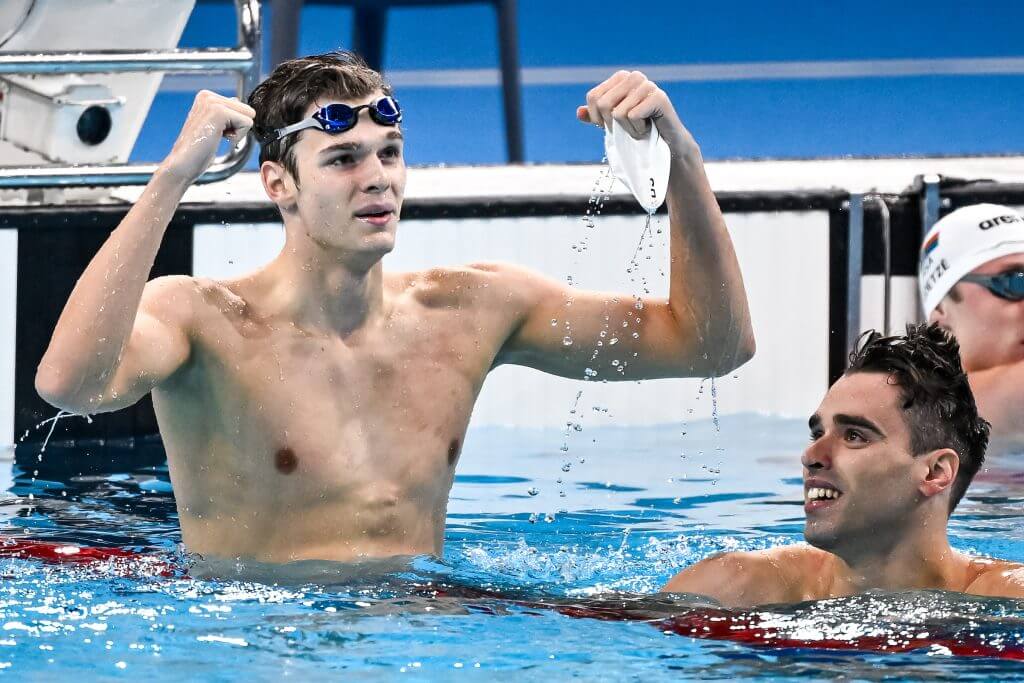
Chasing Barriers: Hubert Kos and Pieter Coetze Targeting 1:52 Territory in 200 Backstroke
At one time, the world record in the women’s 200-meter butterfly was deemed untouchable. It took 16-plus years for the elimination of Liu Zige’s standard, but Summer McIntosh eventually vanquished the super-suit mark. There are no longer any boosted records standing on the women’s side, but three remain in men’s competition, including the 200 backstroke standard of Aaron Peirsol.
The 2009 World Championships in Rome saw Peirsol lower the world record in the 200 backstroke to 1:51.92, an effort that has not been sniffed since its establishment. It is one of only three sub-1:53 markers in the history of the event, joined by Japan’s Ryosuke Irie (1:52.51) and American Ryan Lochte (1:52.96). Only Lochte’s time was produced in a textile suit, arriving as part of his sensational showing at the 2011 World Champs in Shanghai.
This summer, Hungary’s Hubert Kos and South Africa’s Pieter Coetze will look to bump the Club-1:52 membership to five, but will have to achieve the feat apart from one another. While Kos will race at next month’s European Championships in Paris, Coetze will seek to get the job done at the upcoming Commonwealth Games in Glasgow. Can either man cut the gap to Peirsol’s record by a sizable enough margin to suggest it can be broken in the near future?
Kos has been the sport’s dominant 200 backstroker since 2023, when he captured his first world title in Fukuoka. An Olympic crown followed the next year in Paris, and another gold medal at Worlds was earned last summer. That latest world crown was the most impressive performance of the bunch, as Kos clocked a time of 1:53.19, making him the No. 5 performer in history.
Could the Hungarian star dip into 1:52 territory this summer? All signs point to the affirmative. Training under coach Bob Bowman at the University of Texas, Kos was spectacular at March’s NCAA Championships, helping the Longhorns to another team title. More, Kos lowered the NCAA record in the 200-yard backstroke to 1:34.13. The past shows that when Kos improves in the short-course pool, long-course drops typically follow. It will be interesting, then, to see how close Kos can get to Peirsol’s time.
The blueprint for tracking down an iconic record has been established by McIntosh, who early on placed a target on Liu’s mark. That belief was a necessary first step, and from there, the Canadian chipped away. When she went 2:01.99 to narrowly miss, she was visibly miffed, but went right back to work. Ultimately, she secured what she knew was attainable, and Kos – a training partner of McIntosh – could benefit from a similar approach.
As for Coetze, he medaled in all three backstroke events at last summer’s World Champs, highlighted by gold in the 100 backstroke. In the 200 backstroke, Coetze pushed Kos to the touch, claiming the silver medal in 1:53.36. That time moved the South African to No. 7 on the all-time list, and put him in contention for a 1:52 effort.
Coetze has cut significant chunks of time in the 200 backstroke over the past few years, an indication that his endurance is now better suited for the distance and he has improved his pacing. Prior to going 1:53-low last year, Coetze was 1:55.60 in 2024 and 1:56.32. Given that track record, he could be on the cusp of something in the 1:52 range.
It could take time for Peirsol’s record to go down, but this summer will provide a gauge regarding its vulnerability. Expect Kos and Coetze to lead the charge.

