Are you the kind of cyclist who heads to the gym to lift weights, or do you see every minute off the bike as time wasted? The role of strength training in cycling has long been debated, especially when training time is limited.
Research shows that resistance exercises such as squats and deadlifts can boost cycling power, strength and endurance, and gym work is now routine among professional riders. Yet many amateurs still avoid it, wary of bulky legs, fatigue or injury, and short on time.
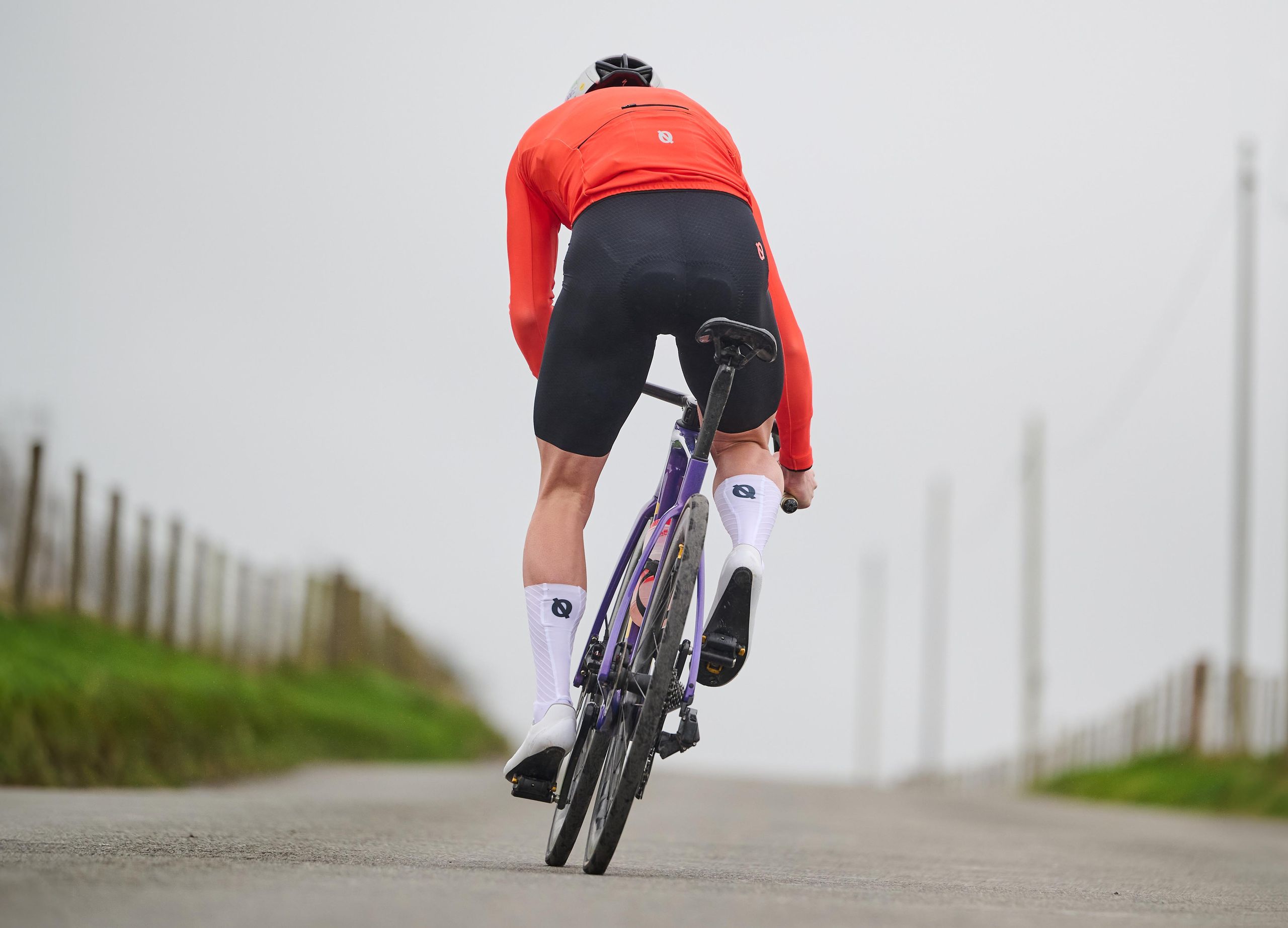
An alternative is on-bike “torque training”: grinding a big gear at low cadence to build strength while you ride. It’s not a new idea, but until recently the evidence has been mixed, leaving cyclists unsure whether it can really match the benefits of the gym.

New research may help settle the debate. A 2025 study published in Biology of Sport by Pallares and colleagues directly compared 10 weeks of heavy squats with on-bike maximal pedal strokes, matching intensity, volume and recovery between groups.
Thirty-seven trained male cyclists maintained their usual riding programme. Twelve added high-intensity, full-range squats on a Smith machine at around 70% of their one-rep max (roughly a 15-rep load, but completing seven per set), while another 12 performed short sets of low-cadence, all-out pedal strokes in a hard gear on a 6% gradient – seven maximal pedal revolutions per set on their own bikes. A control group of 13 riders continued their normal training without additional resistance work.

(Image credit: Future)
The researchers measured leg muscle size, tendon thickness, strength on and off the bike, and markers of aerobic performance such as maximal sustainable power. Both resistance-training groups improved quadriceps size and muscle strength, while the on-bike group also showed similar gains in tendon thickness without increased discomfort.
“High-intensity, low-cadence pedalling may deliver many of the benefits of weighted squats without a trip to the gym”
The researchers concluded that, in this context, on-bike strength training could produce comparable performance improvements to traditional gym-based sessions.
For amateur cyclists short on time, the takeaway is appealing: high-intensity, low-cadence pedalling may deliver many of the benefits of weighted squats without a trip to the gym. Improvements in cycling efficiency were modest, but gains in maximum sustainable power and time to exhaustion suggest real-world performance benefits.
The study also highlights the risks of skipping resistance training altogether. When riders stopped strength work after the intervention, researchers observed measurable declines in both muscle mass and strength, underlining the need for ongoing resistance training, whether in the gym or on the bike.

(Image credit: Ashely Flood)
Gym work versus cycling strength
Sebastian Sitko, the author of Cycling 2.0: Evidence-based training for peak performance on the bike, is a long-time coach and researcher specialising in strength training for cyclists. “In cycling, strength is rarely defined by raw force alone,” he explains. “It’s best understood as the ability to produce and sustain torque across a specific range of cadences.
While a gym athlete might measure strength by a one-rep max, a cyclist views it through the power equation: Power = Torque x Cadence. How that power is produced depends on the challenge – sprinting for the finish line versus grinding up a 20% gradient.”
Sitko breaks cycling strength into two complementary types. Neuromuscular power, or maximal torque, is the ability to recruit the greatest number of muscle fibres instantly-crucial in the opening seconds of a sprint or standing start. In the study, this was measured as maximal dynamic force during both squats and on-bike efforts.
Functional torque, sometimes called “on-bike strength”, is the ability to push a heavy gear at low cadence (around 50-70rpm) without the heart rate spiking, the sort of effort needed to grind up steep climbs or into headwinds when momentum drops. It’s exactly the type of strength riders trained in the study through short, low-cadence, all-out pedal sets on a steep gradient.
Crossover benefits
Sitko continues: “Muscular endurance is perhaps the most critical. It’s the ability to produce a high percentage of your maximal force repeatedly for hours. It’s the difference between climbing a 10% gradient for one minute versus 20.” For endurance cyclists targeting sportives, road races or gravel events, this is often decisive.
“In general, by increasing a cyclist’s force ceiling through off-bike strength training, each pedal stroke becomes a smaller fraction of their maximum capacity,” he adds. “This improves metabolic efficiency, letting the rider sustain higher power outputs for longer periods while delaying fatigue.”
So some form of strength training clearly benefits cyclists, whether you’re a track sprinter, road racer or weekend rider looking to ride faster for longer. The bigger question is how best to do it: on the bike or in the gym? “When discussing the balance between gym and on-bike work, I like to think of it as the difference between building a larger engine and tuning that engine for the road,” Sitko explains.
“The gym is the only environment where we can truly maximise a cyclist’s force ceiling. The bike is a low-impact, high-repetition environment, so it’s physiologically difficult to recruit enough muscle fibres for true strength gains while pedalling. Heavy compound lifts – squats, deadlifts, Bulgarian split squats – allow us to overload the musculoskeletal system, strengthen connective tissues, and build structural integrity in ways that aren’t possible on two wheels.”

(Image credit: Future)
Gym work also offers benefits beyond performance. “This off-the-bike work isn’t just about raw power; it’s about creating a robust chassis that can handle thousands of pedal strokes over a competitive season without breaking down. It’s also better for injury prevention, especially by strengthening antagonist muscles, and for improving bone mass, which can be a serious concern for cyclists.”
On-bike strength work, by contrast, is more cycling-specific and directly transferable to riding, and for time-crunched riders it’s easier to integrate into regular training. “While the gym builds potential force, on-bike sessions help ensure that force is applied efficiently and specifically to the mechanics of cycling,” Sitko says. Still, he cautions that the science is evolving.
“On the bike, we’re trying to teach muscles to apply that new strength through a full 360-degree pedal stroke. I emphasise ‘trying’ because the evidence is mixed. The on-bike protocols with the most scientific backing typically involve a few hard, low-cadence pedal strokes in a heavy gear, where momentum is minimal and torque is high.”
As Sitko suggests, the science is still far from settled. A study published earlier this month in British Medical Bulletin found that cyclists who combined endurance training with heavy gym-based strength work improved several key performance markers, including anaerobic power and aerobic capacity.
“Going to the gym has benefits broader than just cycling performance: protecting bone health, reducing injury risk, maintaining muscle mass.”

Weighted Bulgarian split squats work the key muscle groups in your legs
(Image credit: Future)
By contrast, riders performing “specific” on-bike strength sessions-low-cadence, high-resistance drills – saw no comparable gains. That finding contradicts the earlier study and suggests traditional gym work may offer benefits that on-bike strength training cannot. Although the research by Vicari and colleagues focused on off-road cyclists, who typically face higher torque and lower cadence demands, the results are likely relevant across other cycling disciplines.
Going to the gym has benefits broader than just cycling performance, particularly for older cyclists and masters athletes. A large Norwegian study published in 2024 surveyed 555 male masters cyclists aged 35 and over, and found that, while many reduced or stopped strength work during the race season, their primary motivations, particularly among those over 50, were health-driven: protecting bone health, reducing injury risk, maintaining muscle mass and supporting functional capacity.
That rationale is well supported by wider research. Resistance training is one of the most effective non-pharmacological strategies for increasing or preserving bone mineral density, counteracting age-related sarcopenia (muscle-fibre loss) improving insulin sensitivity and glucose metabolism, and maintaining neuromuscular function and balance – all critical factors in healthy ageing. For masters athletes, strength training is as much about long-term health as it is about immediate performance.
Complementary approaches
ON-BIKE STRENGTH WORK: FOR AND AGAINST

(Image credit: Getty Images)
On-bike strength sessions are highly effective but cannot fully replace gym-based resistance training. A hybrid approach is generally the most effective strategy for committed cyclists.
For: Improves cycling-specific strength by training in the exact mechanics of pedalling. Against: Limited capacity to increase true maximal strength compared to heavy gym lifts.
For: Can be easily integrated into normal rides, ideal for time-crunched cyclists. Against: Minimal impact on bone density and osteoporosis prevention.
For: Safer for the spine and joints compared to heavy squats or deadlifts for cyclists with back issues. Against: Limited ability to strengthen connective tissues and antagonist muscles – important for injury prevention.
For: Allows high-intensity, short-duration efforts that mimic steep climbs or heavy gears. Against: Only a small number of maximal-effort pedal strokes per session can be performed, limiting total training volume.
For: Can maintain or slightly increase muscle size and pedalling power if programmed correctly. Against: Does not provide the structural overload needed for long-term increases in musculoskeletal resilience.
So, can cyclists ditch the gym for good? “Ultimately, the choice of environment depends on the specific adaptation we are chasing,” explains Sitko. “Muscular endurance and torque efficiency may be better suited for the bike.
You simply cannot replicate the metabolic demands or the specific joint angles of a steep climb in a weights room.” Yet that doesn’t mean on-bike work replaces the gym. “On the other hand,” adds Sitko, “maximal force and explosive power are always better suited for the gym because you need the stability of the floor and the ability to lift near-maximal loads to trigger significant neuromuscular changes.”
In reality, the most effective approach is to combine both gym and on-bike strength work. “A sophisticated training programme treats these two environments as complementary: the gym builds the capacity, and the bike refines the application, ensuring that the athlete is not just strong in a general sense, but powerful and efficient in the saddle.”
For many amateur cyclists, however, time is the deciding factor. “If I had to choose between one of them for a time-crunched cyclist, I would go for gym training and would ditch on-bike strength,” concludes Sitko. In other words, don’t rush to cancel that gym membership just yet: lifting weights remains one of the most reliable ways to build strength, resilience and long-term performance on the bike.

(Image credit: Future)
ON-BIKE STRENGTH: SAMPLE SESSIONS
Here are two, evidence-based sessions to try in your own training. If you’re not lifting in the gym, include one maximal torque session and one sustained low-cadence session per week, keeping overall volume manageable. If you are strength training off the bike, replace the maximal torque work with heavy compound lifts and retain the longer, low-cadence efforts as cycling-specific transfer. Perform sessions when fresh, stay seated and prioritise recovery to maximise gains.
1. Max-torque micro-bursts (neuromuscular focus)
Purpose To improve maximal dynamic force and neuromuscular recruitment – your ability to generate high torque quickly at low cadence. This is the on-bike equivalent of lifting heavy weight for low reps.
Terrain Gradient: 4-8% steady climb (or trainer in resistance mode) Surface: Smooth, seated climbing preferred
Gear and cadence Gear: Big gear, typically 50/11-15 outdoors or equivalent resistance indoors. Cadence: 40-60 rpm The gear should feel “borderline grindy” from the first pedal stroke.
Main set From near standstill or very low rolling speed 6-8 sets Each set = 6-8 maximal pedal strokes per leg (roughly 10-12 total revolutions) Every pedal stroke is all-out, maximal intent Stay seated, focus on driving through the full 360° stroke Full recovery: 2.5-3 minutes easy spin between sets
What it’s doing Increasing peak torque production Improving rate of force development Enhancing recruitment of high-threshold motor units Potentially increasing cycling-specific maximal strength
Frequency: 1-2 times per week Ideally separated by at least 48 hours Best placed early in a ride when fresh
2. Sustained low-cadence (functional torque focus)
Purpose To improve functional torque and muscular endurance – the ability to push a heavy gear at low cadence without cardiovascular drift. This bridges maximal strength and sustained climbing power.
Terrain Gradient: 3-6% steady climb or trainer Long uninterrupted effort preferred
Gear and cadence Gear: Big gear (e.g., 50/13-17 depending on slope) Cadence: 50-65 rpm Effort should feel muscular, not aerobic-limited
Main set 4-6 repetitions 4-6 minutes per interval Ride at 88-95% of FTP Cadence strictly 50-65 rpm Stay seated 3 minutes easy spin recovery
What it’s doing Improving torque sustainability Raising sub-threshold force tolerance Reinforcing motor patterning under load Potentially improving time-to-exhaustion at high steady efforts.
Frequency: Once a week Best used in base or early build phase

