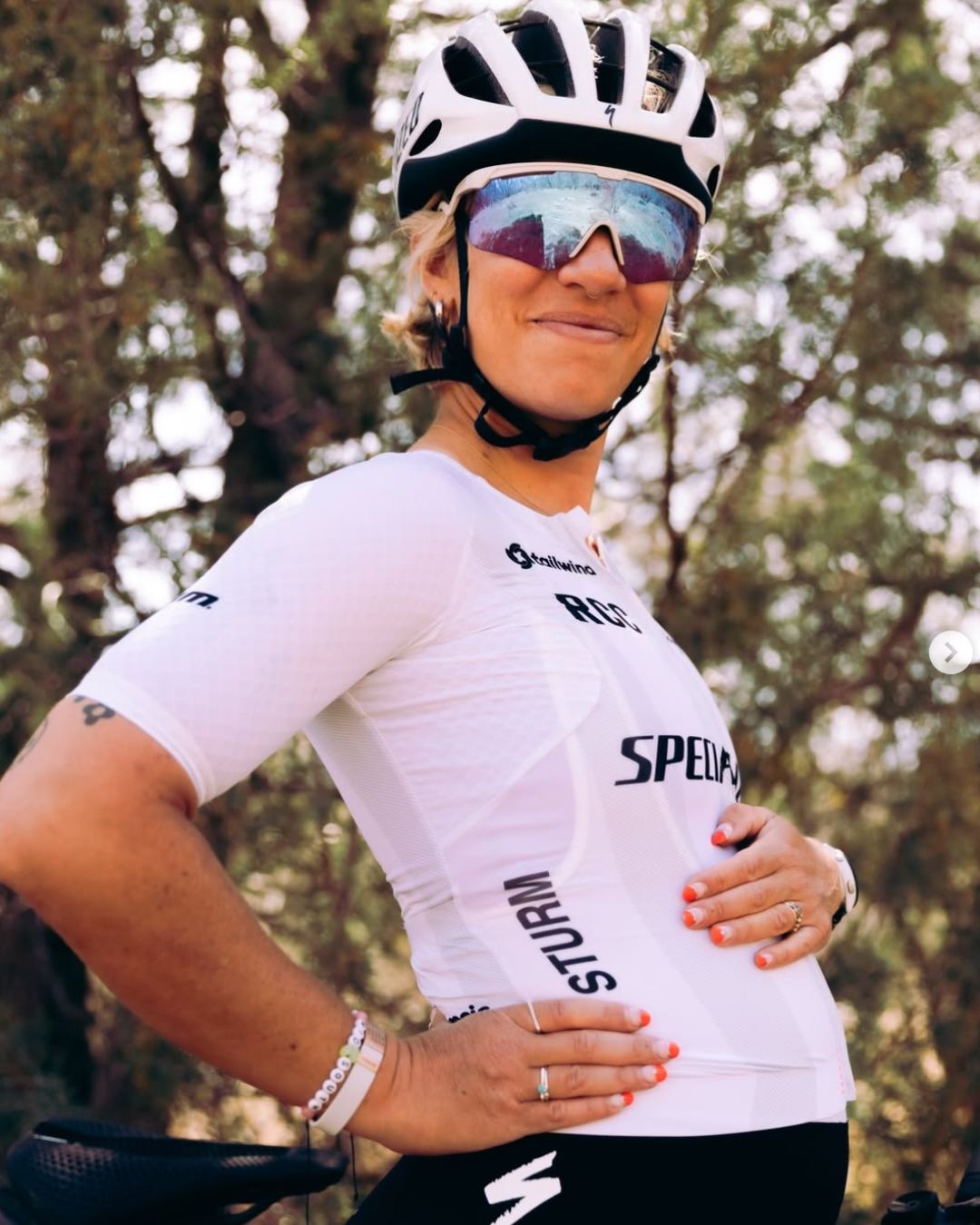
When Sarah Sturm rolled across the line at The Traka 100 in Girona, Spain, this past weekend, the result was, for once, beside the point. At 28 weeks pregnant, the American gravel star said the experience was less about racing and more about enjoying the ride and discovering what her body was still capable of.
“It felt OK,” Sturm told Cycling Weekly. “I had done a training camp with Rapha the week before, and I think it sort of reset my expectations on what I am capable of doing.
“Lining up with professional athletes, I realise I was obviously much slower, but the effort is still there and it feels really good to push myself within those boundaries,” she said. “It felt really good to move and, specifically, ride. It actually feels a lot better than sitting on an aeroplane, for example.”

“I’m not racing, and in a lot of ways it felt really good, but also, definitely, uncomfortable. I don’t want to skim past that. Nothing I’m doing now is comfortable. It’s uncomfortable to sleep, to walk, to eat, to ride. But you just live in this state of discomfort, so I was really feeling quite happy to be healthy enough to ride my bike at a bike race in Spain.”

(Image credit: TrainingPeaks)
Earlier this year, Sturm was instrumental in bringing about Life Time’s new pregnancy policy. Under the policy, athletes who become pregnant after being selected for the prestigious off-road series can defer their roster spot to the following season without penalty, a move widely praised as a big step forward for women in gravel racing.
Sturm’s appearance at gravel events while pregnant also comes amid wider conversations around pregnancy in elite sport and the lack of long-term protections historically afforded to female athletes. For female athletes, there’s often a lot of uncertainty surrounding sponsorship, contracts and competition during pregnancy.
Last season, fellow gravel racer Iz King wrote openly about continuing to race while pregnant, arguing that visibility matters for the future of women’s sport.
“Racing this season wasn’t about trying to be better or faster than my non-pregnant competitors,” King wrote for Cycling Weekly. “It was about setting an example for what it could look like to be a pregnant professional athlete.
“How do you inspire others? How do you prove your value to your sponsors? How do you break down some of the pre-conceived notions about what a pregnant person is capable of? And how do you do all of that while putting your baby’s safety first?”
Sturm echoed much of that sentiment.
“My message for women, female athletes everywhere, is truly just: don’t let other people tell you what you can and can’t do with your body,” she said. “Pretty simple, and yet one that we as a society don’t really seem to grasp, especially for women and specifically, female athletes.”
She added that while public judgment around pregnant athletes can often be critical, she hadn’t experienced a backlash of her own.
“No one’s really shared their judgment with me, which is really appreciated because I am doing what I can do based on my conversations with my coach and doctor,” Sturm explained, stating, “I was cleared to be in Spain and to be riding my bike.”
Sturm also stressed that she approached the event conservatively and with safety at the forefront. She started near the back of the field rather than alongside elite racers and rode with support throughout the day.
“I am a professional, so I know how to safely be in a group and I started at the back of the 100 for a reason,” she said. “I have no business starting with WorldTour riders at the front.
“And with that, I just gave myself a lot of space on the descents in case someone had a mishap, and I would have time to react. At no point did I feel like it was unsafe for me.”
Her husband, Dylan, rode alongside her, as did a friend, and the group had multiple bailout options planned throughout the route.
“I took it hour by hour and, yeah, finished it,” Sturm said. “It was really great to get a lot of perspective on a race that I’ve done four times. We started at the same start and the finish was the same, and it was really fun to do that in a very different state.”
Explore More

