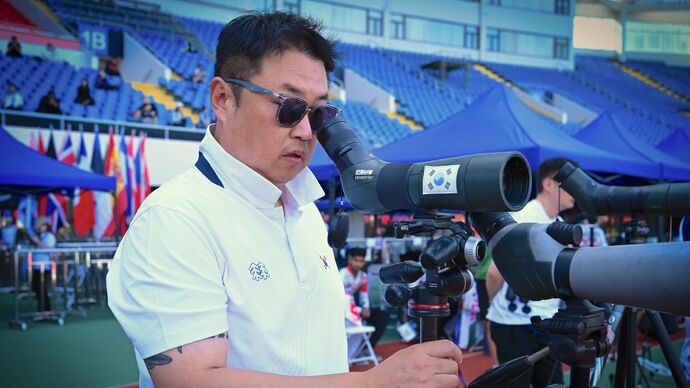
Despite his long list of medals at major competitions, Oh missed out on competing at the Rio 2016 Olympic Games, coming fourth in the trials that year – according to him, he lost a place by just a single point.
“Because of my experience [in London], I was kind of obsessed with the Olympics. My life changed when I went there, and so I felt I had failed.” It was all the more remarkable that he managed to return to the Korean team in 2021 for Tokyo – just a few weeks shy of his 40th birthday and 12 years after he first made his international debut for Korea.
Oh was also well-known for an unconventional technique by Korean standards, and struggled with injury in his later years competing. “The biggest difference between shooting when I was young and shooting in my 40s, just before I retired, was definitely the physical aspect. When I was younger, I used to feel a lot of subtle sensations, but as I shot the bow and got older, the physical demands took over, and I ended up using my large muscles to shoot.”
“Consequently, I couldn’t shoot with the same precision, and that was the most difficult part. It was a bit of a struggle not being able to consistently achieve high scores. That was a challenge, but I’m always trying my best.”
“But there are older archers doing really well, like Brady Ellison. It’s something the athlete has to experience for themselves, so how they think about it, and how they overcome it, is a challenge they have to solve themselves.”
With another Korean legend, Im Dong Hyun having successfully moved into coaching in Paris, the Korean federation must surely be pleased that they are again going into a major tournament year with such experienced and successful hands both in front of and behind the line.
“We’re practicing hard, I‘m giving all my attention to the athletes, and we’re doing everything to get the gold medal in the Asian Games. I’ll do my best,” said Oh.
With thanks to Iwan Blakeway.

