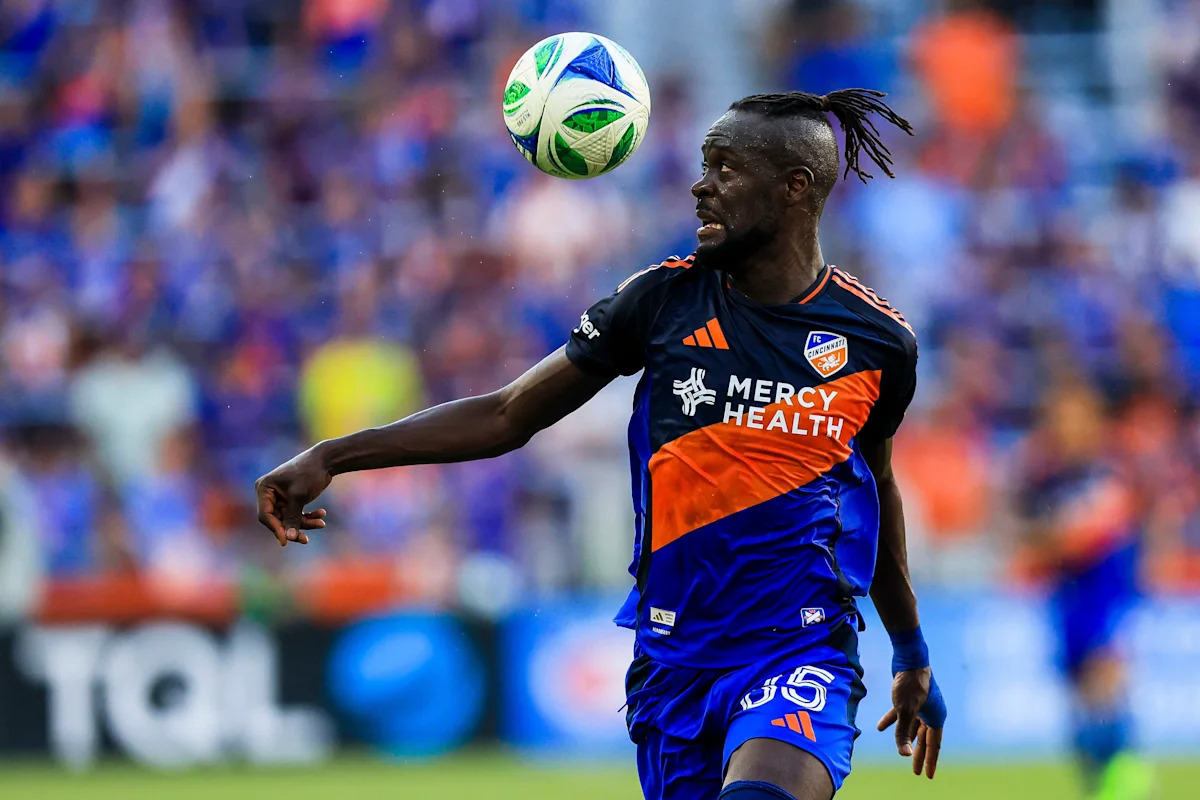
Kei Kamara still hasn’t processed it.
Not the Apple TV gig. That was somewhat expected. Why wouldn’t MLS’ rightsholder put the former forward on air? His smile is contagious, his enthusiasm talking about the league, believable.
Advertisement
During his decades-long career as a player, he was happy to play along for a photo shoot or social media video, to do an extra interview or speak in a news conference.
No, Kamara knows he belongs in the studio. He still can’t believe everything that came before it. The two decades of scoring goals for a dozen MLS teams with two stops in England and even a long layover in Finland.
“The fact that I became a professional soccer player? I don’t know, man. I came from nothing, a refugee, I moved to America and then all the sudden played soccer. So, I always have this big joy on my face,” Kamara told USA TODAY Sports this week. “Whenever they wanted me to do something, I was so happy to be there … it just became part of me and I love being on camera.”
It is a long time to live in a state of disbelief, yet that is a sign of how remarkable Kamara’s journey has been.
Advertisement
Born in Sierra Leone, Kamara spent his childhood in the midst of a civil war before fleeing with his family to the Gambia and, as a teenager, being welcomed into the U.S. as a refugee. He became a solid high school player in southern California and did whatever possible to sign on as a pro. His choice to attend Cal State Dominguez Hills, a university whose campus houses the stadium where the LA Galaxy (and Chivas USA at the time) call home, was not an accident.
The time around the club ended up with Kamara being drafted by the Columbus Crew in 2006 and joining up with former Galaxy coach Sigi Schmid. That was the start of a decades-long career that ended with Kamara as the player who scored more goals all-time than any player but one.
Regularly he would find the back of the net, often on a header, and run off to celebrate with his trademark heart made with both hands.
Advertisement
After his time with the Crew, he kept going and going and going. Now 41, Kamara was inspired by LeBron James – though he didn’t quite match the longevity of the now-Philadelphia 76ers star – and was enthused to see players like Cristiano Ronaldo and Luka Modric on the field at the 2026 World Cup in their 40s.
It made sense, though, for Kamara to hang up the boots. Between occasional lingering concussion symptoms and sharing the locker room with players who weren’t born when his career started, Kamara decided to retire as a player earlier this year. Saturday, he’ll be back on Apple TV, as the league’s house organ tries out new personalities.
Kamara may be a natural and he may have a palpable enthusiasm about MLS, but there’s no guarantee this is his next step. His role in the studio Saturday, the second appearance in as many weeks, is temporary. He may stick with it. He may coach, having acquired his B license. He may put lessons learned in acting classes to use and go into scripted TV.
Whatever his next job looks like, he will continue to be the same person, the one with a big smile a love for local soccer and who is always thinking about things back home in Sierra Leone. His HeartShapedHands Foundation works to help kids there pay school fees and award scholarships.
Advertisement
Kamara suited up for the Sierra Leone national team, helping the Leone Stars return to the African Cup of Nations in 2021 and end a 12-tournament drought at the continental championship. While his eight international goals tie him as the all-time leading scorer, he often was pressed into duty to cover for a place where the national team was wanting.
“I was more there to celebrate, to help,” he said. “I sacrificed positions, playing left wing, right wing, holding midfield, I just wanted to do anything to help frame the country in a good way.”
In a way, that’s how Kamara views his place now in the North American soccer ecosystem. While many players who have spent years at one club have transitioned into club ambassador roles, the well-traveled Kamara joked to MLS commissioner Don Garber that he should take on a more global role given his itinerant career.
Advertisement
“Don, I’m a league ambassador!” he told the commissioner. “It’s so weird how much I love MLS, which it’s cringy to some people when I say that, but I’m like ‘Guys I’ve played in around the world!’ I was in England and everybody kept asking me about America, America, and I kept telling them just watch.
“For me, yes, being a part of American soccer and being able to tell the stories like being in Columbus or growing up in LA and having to work for Los Angeles Galaxy and Chivas USA and now playing and being second highest-goal scorer, let me tell stories that can bring people and fans because I was a fan! I was part of the Riot Squad in LA, I jumped around!
“When I connect with clubs where I’ve played, I live in Kansas City, and I know my veterinarian or the dentist are the same ones in the crowd dancing and cheering for you in the weekends. So, I tell those stories, and I’m so proud to be able to tell the American soccer story.”
Even after 20 years, it’s a story he still can’t totally believe belongs to him.
Advertisement
Some things got away from Kamara in his long career. He’ll admit it. He was ring-chasing a bit as the end drew closer, but that MLS Cup he desperately wanted to lift still escaped him. He never did put on the badge of the LA Galaxy, even after hanging out at so many trainings. His Sierra Leone career meant he couldn’t play for his other nation, the U.S., on the international stage.
But he will be remembered, in LA, in Kansas City, in Columbus, in Houston, in so many other MLS markets and in Sierra Leon not for what he didn’t achieve but for what he did.
Now, a new chapter is starting. Those fans will be watching to see what Kamara does next – whether he’s processed what he’s doing or not.
This article originally appeared on USA TODAY: MLS legend Kei Kamara steps into Apple TV studio as he figures out what’s next

